
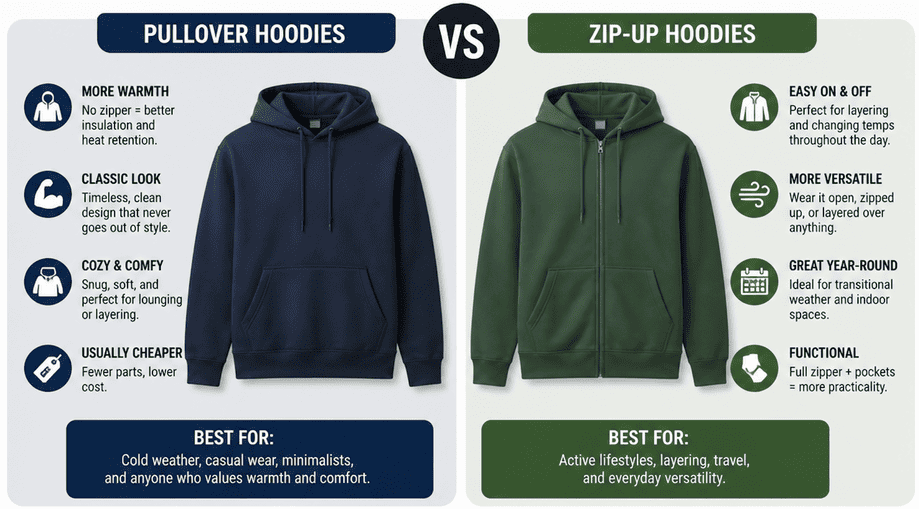
TL;DR: Pullovers run warmer, cost less, and hold their shape longer. Zip-ups give you temperature control, easier layering, and the obvious convenience of not having to pull anything over your head. Pick based on your daily environment more than your aesthetic preference. Pullover if you want maximum insulation and a clean streetwear line; zip-up if you’re constantly moving between heated buildings and cold streets, or if you live in structured jackets.
The 30-Second Verdict (Skip Here If You’re in a Rush)
Side by side, the functional split is pretty clean. Here’s how they stack up across the categories that actually come up in daily use.
| Category | Pullover Score | Zip-Up Score | The Winner & Why |
|---|---|---|---|
| Warmth | 5/5 | 3/5 | Pullover. Unbroken front panel traps heat. |
| Versatility | 3/5 | 5/5 | Zip-Up. Works as mid-layer and a light outer. |
| Durability | 4/5 | 2/5 | Pullover. No hardware, no hardware failures. |
| Price | 5/5 | 4/5 | Pullover. Usually 10-20% less due to simpler construction. |
| Style/Drape | 5/5 | 3/5 | Pullover. Sits flatter without zipper rippling. |
| Layering | 3/5 | 5/5 | Zip-Up. Less bunching under stiff outerwear. |
| Convenience | 2/5 | 5/5 | Zip-Up. Comes off without catching on your glasses. |
Buy a pullover if: you want maximum warmth, you care about a clean visual silhouette, or you need something that survives years at the gym.
Buy a zip-up if: you commute through varying temperatures, you wear it open over a t-shirt, or you just hate pulling tight clothing over your head.
Where Each Style Actually Wins (By Use Case)
Generic pros and cons lists ignore the way people actually wear these things. Preferences shift hard depending on the scenario, and the same person will often want both for different reasons.
- Gym and warm-ups: Zip-up. The ability to vent heat as your heart rate climbs is why most athletic training tops are zip designs in the first place.
- Dog walks and cold mornings: Pullover. Continuous front panel blocks wind better, and an uncut kangaroo pocket is a noticeably warmer hand-muff than a bisected zip pocket. Anyone who’s tried to keep their hands warm in a zip-up at 6 a.m. already knows this.
- Travel and flights: Zip-up. TSA, plus the cabin temperature swings between 62°F and “why is this a sauna,” means you want something you can take off without standing up.
- Office casual: Zip-up. Worn open, a fitted zip mimics a cardigan, which gets you closer to acceptable in most relaxed corporate environments.
- Photography and content creation: Pullover. No metal zipper means a flatter chest profile, and you avoid the awkward belly-wave that happens when you sit down in a zipped hoodie.
- Sleep and lounging: Pullover, obviously. Falling asleep on a zipper track is its own punishment.
Warmth — Why Pullovers Are Measurably Hotter
Pullovers run warmer than zip-ups because they keep a continuous fabric panel across the chest. In apparel thermodynamics this gets measured in CLO values, and a solid front panel traps the body’s boundary layer of air much more efficiently than one that’s been cut down the middle.
Adding a zipper introduces two thermal liabilities. The zipper track itself creates hundreds of micro-gaps where wind penetrates. And the zipper acts as a thermal bridge: metal and dense plastic conduct heat away from the sternum and pull cold air right in against the torso. For static activities in genuinely cold climates, the pullover wins on the math. For humid or high-output situations, the zip-up’s ability to dump heat fast is the smarter performance choice. Same garment weight, totally different behavior.
Durability — What Actually Breaks First
Pullovers outlast zip-ups in everyday wear because the zipper is the most common mechanical failure point on a hooded sweatshirt. Nothing else on the garment is even close.
A quality YKK zipper is engineered to handle 12,000 to 15,000 open-close cycles. Generic zippers on fast-fashion hoodies frequently fail after 300 to 500. That’s not a typo. When a zip-up does fail, the repair economics are bad. Tailors typically charge $25 to $55 to fully replace a separating zipper (SewRob, for instance, lists separating zipper installation at $55.25, with slider-only replacement around $18). On a $40 hoodie, you’re not doing that. You’re throwing it away.
Pullovers skip the hardware problem entirely. Their main failure mode is neckline ribbing that stretches out from repeated over-the-head wear. A blown-out neckline degrades the fit but doesn’t kill the garment the way a destroyed zipper track does, and frankly a stretched neckline is half the appeal of an old pullover anyway.
Fit, Drape, and How Each Looks on Camera
Structural differences dictate how each one sits on the body. A pullover creates a boxier, cleaner front silhouette. The weight of the fabric pulls everything straight down, and the hood usually sits flatter against the upper back. For anyone shooting content or just paying attention to how clothes photograph, the pullover comes out ahead in mirror selfies and static shots because the fabric stays flush.
A zip-up behaves differently. Open, the two front panels create a V-shape that elongates the torso and pulls the eye vertically, which is genuinely flattering. Closed and seated, the rigid zipper tape has nowhere to go and buckles outward in that fabric ripple across the stomach. You see it constantly on camera and once you notice it you can’t unsee it.
Layering Math — Stacking Order Matters More Than You Think
Outerwear fit determines which hoodie style you should buy. A heavyweight pullover under a slim jacket is one of the most common style errors I see, because it compresses the chest and restricts arm movement, and then the wearer blames the jacket.
If you’re layering a midweight hoodie (around 300 GSM) under a denim jacket or leather bomber, add 1 to 2 inches to the jacket’s chest measurement to fit the extra fabric. Zip-ups are generally easier to layer over t-shirts and under structured coats because opening the front reduces bulk across the sternum. Pullovers work as mid-layers only when paired with relaxed or oversized outerwear, a loose topcoat or an oversized puffer, where chest compression isn’t a problem. Obviously you wouldn’t try to put a 500 GSM pullover under a slim trucker.
Price, Cost-Per-Wear, and Resale Value
Zip-ups generally cost 10 to 20% more than pullover versions of the same model. The delta comes from hardware and the extra labor needed to bisect the front panel, split the kangaroo pocket, and stitch the zipper tape. Carhartt’s Rain Defender heavyweight pullovers retail around $89.99, while the full-zip starts at $99.99 — the gap is consistent across most workwear brands. Fast fashion sometimes flattens this. Uniqlo, for example, prices both their Sweat Oversized Pullover and the Zip-Up at S$49.90 in Singapore, which tells you something about where margins are being absorbed.
Resale is where pullovers really win. Vintage 90s Champion Reverse Weave pullovers go for $35 to $135 on Grailed depending on the collegiate graphic. The unbroken front panel is the canvas for the graphics people actually want, which is why pullovers hold value years after purchase and zip-ups mostly don’t.
Fabric and Weight — What to Look For Regardless of Style
Whether you go pullover or zip-up, fabric weight is doing most of the work. Apparel density is measured in Grams per Square Meter, or GSM.
- Lightweight (200–280 GSM): Summer evenings, gym, high-intensity activities. Usually French terry — looped interior, smooth exterior.
- Midweight (280–350 GSM): The industry standard, and the weight most brands sell as their default. Warm enough for autumn, light enough to layer.
- Heavyweight (350–450+ GSM): Winter and outdoor work. Dense, structured, usually a brushed fleece interior.
- Ultra-heavyweight (500+ GSM): Luxury streetwear territory. House of Blanks, 3sixteen, that part of the market. Extremely stiff, functions almost like a standalone jacket. Anecdotally they’re some of the only hoodies I’ve seen genuinely last a decade of daily use, though by year three they’ve usually softened enough that they no longer stand up on their own the way they did out of the box.
The Honest Downsides Nobody Mentions
Brand product descriptions skip the daily friction.
Pullover downsides. Taking a heavy pullover off mid-day destroys styled hair, pulls off glasses, smears makeup onto the collar. After a workout, peeling off a damp clingy pullover is a small claustrophobic event nobody warns you about until it happens.
Zip-up downsides. The zipper tape often shrinks at a different rate than the cotton body during laundering, which leaves you with a warped, wavy zipper line — the “bacon zipper,” and once it goes bacon it stays bacon. Pulling the zip up to your collarbone routinely catches chest hair or beard hair, which is its own special wake-up. And the metal hardware degrades fast in salt-air climates, faster than people expect.
Final Recommendation by Buyer Type
Buy a pullover if you’re a:
- Skater or streetwear person who wants a boxy, structured drape.
- Content creator chasing a clean chest profile on camera.
- Cold-climate resident who needs zero wind penetration.
- Secondhand shopper looking for vintage graphics that hold resale.
- Couch-sleeper who hates metal hardware against their face.
Buy a zip-up if you’re a:
- Commuter caught between freezing subway cars and overheated offices.
- Gym-goer who needs to regulate temperature mid-workout.
- Traveler navigating airport security and cramped airline seats.
- Denim jacket wearer who needs a flat mid-layer.
- Office-casual professional using it as a stand-in cardigan.
Buy both if: you treat the pullover as your winter weekend armor and the zip-up as your weekday utility tool. Honestly that’s how most of us end up anyway.
Frequently Asked Questions
1. Are pullover hoodies warmer than zip-up hoodies?
Yes, generally. The continuous fabric across the chest blocks wind entirely, and a zipper acts as a thermal bridge that lets cold air in and body heat out.
2. Which lasts longer, a pullover or a zip-up hoodie?
Pullovers, by a wide margin. Zippers are the most frequent mechanical failure point on sweatshirts, and the math on repair is brutal: replacing a broken slider or warped track on most hoodies costs more than the hoodie is worth, especially if you’re buying anywhere below the $100 tier. Even on quality pieces, you’re often paying $40 to $55 for a job that takes a tailor about twenty minutes. Most people just don’t bother. They wear it open until the rest of the garment gives up, then donate it or use it as a paint shirt. A pullover gets replaced when it stops fitting; a zip-up gets replaced when the zipper dies, and that’s usually first.
3. Why are zip-up hoodies usually more expensive?
Hardware cost and extra labor — cutting and stitching the front panels, attaching the zipper tape, splitting the pocket.
4. Can you wear a pullover hoodie to the office?
Tough. The athletic silhouette doesn’t translate well. A well-fitted dark zip-up worn open over a clean t-shirt reads closer to a cardigan and clears most business-casual bars.
5. What’s better for the gym, a pullover or a zip-up?
Zip-up. Vent heat by unzipping as you warm up, take it off without dragging damp fabric over your face.