
TL;DR: Cotton fibers have a hollow internal structure that absorbs sweat and breathes. Synthetics don’t. That’s most of the story. Cotton dries slow and shrinks, so the spec sheet matters more than the “100% cotton” tag — aim for 300+ GSM, ringspun yarn, and a combed finish.
The Fiber Itself: What Cotton Does That Polyester Can’t
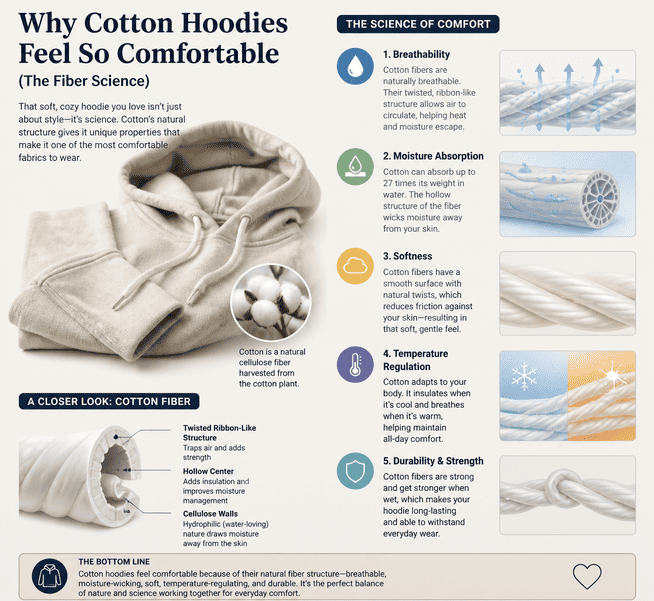
Cotton fibers have a hollow internal channel called a lumen. Polyester doesn’t. That single structural difference is responsible for almost every comfort claim in this article.
At 65% relative humidity and 21°C, cotton maintains a moisture regain rate of approximately 8.5%. Polyester sits at 0.4%. The lumen makes up to 15% of the cotton fiber’s volume — empty space that traps air for insulation while the cellulose walls pull sweat away from the skin without the fabric immediately feeling wet. Polyester is essentially extruded plastic, so there’s nowhere for moisture to go. Sebum and sweat spread across the hydrophobic surface, which is great for bacteria and bad for anyone wearing the hoodie indoors.
| Fiber Type | Moisture Regain % | Breathability | Hand-Feel |
|---|---|---|---|
| 100% Cotton | ~8.5% | High | Soft, porous, dry |
| Cotton/Poly Blend (80/20) | ~6.8% | Medium-High | Smooth, slightly structured |
| 100% Polyester | ~0.4% | Low | Slick, static-prone, warm |
Why Two Cotton Hoodies Can Feel Completely Different
The tag says “100% cotton.” That tells you nothing.
Standard upland cotton has a staple length of about 1 inch (25mm). Supima and Pima are extra-long staple cottons, averaging 1.5 inches (38mm). Longer fibers mean fewer connection points when spun into yarn, which means fewer prickly micro-ends poking out at the surface. That’s where the scratchiness and pilling come from on cheap cotton, not from the cotton itself.
Then there’s the spin. Open-end spinning runs roughly seven times faster than ringspinning, and you can feel it — the yarn is bulkier, rougher, and degrades visibly within a season. Ringspun cotton continuously twists and thins the strands around a spindle, producing finer, stronger yarn. Add a combing step before spinning to mechanically strip out short fibers and impurities, and you’ve got combed ringspun cotton, which is as soft as a base material gets for apparel. Most cheap hoodies skip the combing and most “premium” hoodies don’t mention whether they bothered.
What to look for on the tag:
- “Supima” or “Pima” — extra-long staple fibers (38mm+)
- “Combed Ringspun” — purified and tightly twisted
- “Carded Open-End” — budget cotton, expect rough texture and fast degradation
GSM, Weaves, and the Inside of Your Hoodie
GSM (grams per square meter) measures fabric thickness. Lightweight summer hoodies run 200–280 GSM. Midweights sit between 280 and 340. Heavyweights start at 350 and climb past 800 GSM in double-layer constructions, at which point you’re basically wearing a blanket with sleeves.
The interior weave matters more than most buyers realize. French terry uses an unbrushed loop-back knit — the loops stay intact on the inside, which lets the fabric breathe and pulls moisture off the skin. A 300 GSM French terry hoodie is genuinely versatile for spring and fall. Fleece takes that same base and mechanically brushes the inner loops into a fuzzy nap. That napping traps dead air, which is why fleece is 20–30% warmer than French terry at the same GSM. The trade-off is breathability. Fleece runs warm fast.
| Weave Type | Weight Range | Best Use Case | Feel |
|---|---|---|---|
| French Terry | 240–350 GSM | Spring/Fall, layering | Smooth outside, looped inside, breathable |
| Brushed Fleece | 280–400+ GSM | Winter | Plush, fuzzy interior, heavy heat retention |
| Double-Layer | 600–800+ GSM | Extreme cold | Stiff, structured, heavy drape |
Cotton vs. Polyester vs. Blends — Honest Comfort Comparison
Cotton wins for everyday wear, lounging, and sleeping. Polyester wins for athletic activity and wet conditions. That’s the whole comparison, and I wish more brands would just say that instead of pretending one fiber is universally better.
A 100% cotton hoodie breathes well and doesn’t hold onto oily body compounds the way polyester does. The downside is structural memory — pure cotton sags at the hem and cuffs after enough wear and washes. An 80/20 cotton-poly blend gives up a little breathability for a lot of durability. That 20% polyester is what keeps the kangaroo pocket from drooping at month four. A 100% polyester fleece traps heat and dries fast, but it generates static, holds onto body odor in a way no amount of detergent can fully fix, and feels clammy indoors because the fibers can’t absorb ambient room moisture.
Comparison Matrix
- 100% Cotton: Highest initial softness. Slow drying time (2–3x longer than poly). Holds structure poorly. Highly breathable.
- 80/20 Cotton/Poly Blend: High softness, moderate drying, excellent shape retention, minimal pilling.
- 50/50 Blend: Moderate softness, fast drying, prone to long-term pilling.
- 100% Polyester Fleece: Lowest natural softness, fastest drying, traps heat, retains odor.
Where Cotton Wins — and Where It Genuinely Doesn’t
Cotton dominates low-intensity scenarios. Static activities in 50–60°F weather. Sleeping. Lounging. Post-workout cooldowns where the fabric needs to absorb residual sweat without trapping body heat.
Cotton fails in high-sweat or wet environments, and the failure mode is dramatic. A standard heavyweight hoodie weighs 400–800 grams dry. Soaked in rain, an 800-gram cotton hoodie can exceed 1 kilogram, cling to the skin, and lose its insulating properties completely. In freezing temperatures, wet cotton against bare skin accelerates body heat loss in a way that’s genuinely dangerous on a long hike. This is why no serious outdoor brand makes cotton base layers anymore.
Decision Box
- Choose Cotton: Working from home, sleeping, layering in mild dry weather, post-workout recovery.
- Choose Synthetic/Blend: Running, hiking, commuting in rain, travel with limited drying time.
Skin Sensitivity, Allergies, and the Hypoallergenic Question
Cotton is generally better for sensitive skin — hypoallergenic, breathable, free of the petroleum chemistry in synthetics. With one caveat. The finish matters as much as the fiber.
Some overseas manufacturers use formaldehyde resins to make cheap cotton knits temporarily wrinkle-resistant. That residue can linger through the first several washes and trigger contact dermatitis in anyone with reactive skin. The way to screen for this is the OEKO-TEX Standard 100 certification, which tests every component of the garment — yes, including the zipper pull — for over 350 harmful substances, covering heavy metals, azo dyes, and formaldehyde.
One thing worth flagging: an “organic cotton” label only describes how the raw crop was grown. It says nothing about post-weaving chemical finishes. There’s research showing some organic cotton infant garments tested higher for formaldehyde residue (up to 55.7 mg/kg) than conventional cotton, because of what got applied after the fiber was certified.
The Real Trade-offs Nobody Mentions
The big one is dimensional instability. Untreated cotton knit shrinks 3–7% on the first wash and up to 10% if you hot-dry it. Manufacturers handle this with sanforization, a mechanical pre-shrinking process that brings post-purchase shrinkage down to roughly 1–1.5%. Polyester shrinks less than 1% out of the gate, which is why so many activewear brands love it.
Cotton also takes two to three times longer to air-dry than a synthetic equivalent, and washing it aggressively beats the fibers up. Running a cotton garment at 40°C with a 1,000 RPM spin cycle causes a 12.3% tensile strength loss over five cycles, which is more damage than most people realize they’re doing every weekend.
Honest Pros & Cons
- Pros: Breathable, non-static, doesn’t retain body oils, safe for eczema-prone skin
- Cons: Heavy when wet, slow drying, shrinks, needs delicate wash cycles
How to Pick a Cotton Hoodie That Stays Comfortable for Years
Buying based on the “100% cotton” tag guarantees nothing. You need the spec sheet, and most brands won’t volunteer it unless you ask.
Check for ringspun combed cotton, which avoids the scratchiness of open-end yarns. For year-round use, target a midweight fabric between 280 and 340 GSM. If you’re going to wear the thing daily, an 80/20 cotton-poly blend will outlast pure cotton by a wide margin because the polyester keeps the cuffs and pocket from stretching out. I still default to 100% cotton for anything I’m sleeping in, even though the 80/20 lasts longer — old habit, hard to shake.
Care Checklist:
- Wash at 30°C (cold) to prevent fiber contraction
- Low spin cycle (600 RPM or lower)
- Wash inside out to protect the outer face from drum abrasion
- Skip fabric softeners — the cationic surfactant residue coats the fibers and kills the hand-feel