
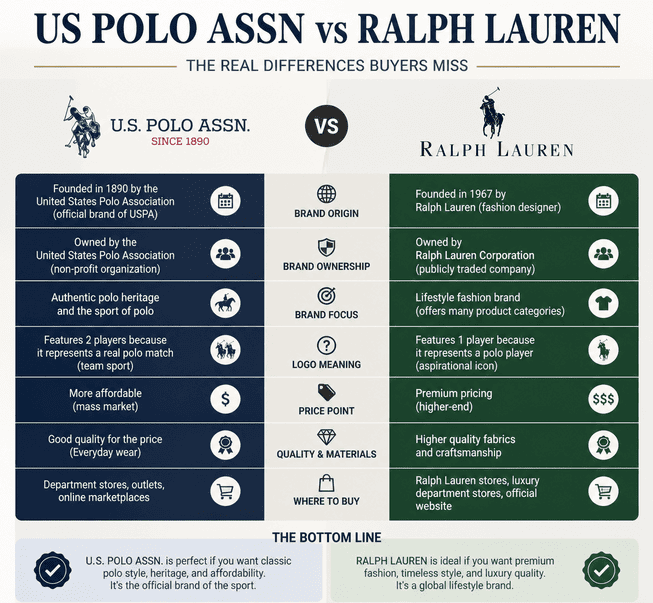
US Polo Assn and Ralph Lauren are completely unrelated companies. USPA is licensed by the United States Polo Association, founded 1890, which is the sport’s actual governing body. Ralph Lauren is a fashion brand founded in 1967 that adopted polo imagery for its aesthetic. Ralph Lauren polos typically cost four times more, and the gap comes down to fabric weight, fit construction, and the cost of decades of brand-building. Some of that gap is real value. Some of it isn’t.
One Brand Plays Polo. The Other Just Dresses Like It.
US Polo Assn operates under USPA Global Licensing, the apparel arm of the United States Polo Association, which has governed the sport in America since 1890. The apparel line itself is much newer. It didn’t launch commercially until 1981, and the original point of it was to generate revenue for the sport’s programs.
Ralph Lauren has no formal connection to the sport. Designer Ralph Lauren founded the company in 1967 selling men’s ties, and he picked up the “Polo” name and the horseman logo in 1972 because it projected the right kind of aspirational, vaguely WASP-y lifestyle for what he was building. That’s it. There’s no governing body involvement, no charity arm, no sport-funding mechanism. It’s a fashion brand that borrowed the imagery.
| Feature | US Polo Assn | Ralph Lauren |
|---|---|---|
| Founding Year | 1890 (Sport), 1981 (Apparel) | 1967 (Company), 1972 (Polo logo) |
| Origin Industry | Sports Governance | Fashion & Menswear |
| Ownership Today | USPA Global Licensing | Ralph Lauren Corporation (NYSE: RL) |
| Connection to Sport | Official governing body | Purely aesthetic/lifestyle |
The Logo Trick Your Eye Falls For
Shoppers confuse the two brands constantly, and the embroidered chest logos are why. Both feature a mounted polo player. The technical details aren’t subtle once you know what to look for.
- Ralph Lauren: A single polo player. Horse mid-gallop, rider’s mallet raised high. The embroidery is dense, with a distinct raised 3D profile.
- US Polo Assn: Two polo players. Foreground rider’s mallet is up, background rider’s mallet points down.
- Text Identifiers: Because of trademark litigation, USPA usually has to put “U.S.P.A.” or “1890” near or below the logo so it’s not mistaken for the competition. Ralph Lauren just uses the icon.
- Size Variants: Ralph Lauren has a “Big Pony” line with oversized, multi-colored logos. USPA mimics this directly with enlarged double-horseman versions.
That last point is where things get awkward, because the only reason to scale a logo up that aggressively is to make sure people see it from across a parking lot.
Inside the Courtroom — Decades of Trademark Wars
Ralph Lauren and USPA have been fighting in federal court for almost forty years. It started in 1984 when Ralph Lauren sued for trademark infringement. A federal judge ruled USPA could sell apparel with a mounted polo player as long as the design was distinct enough from Ralph Lauren’s mark.
Then it escalated. In 1999, USPA tried to publish a magazine called Polo. Ralph Lauren sued, judge made them rename it. In 2006, a Manhattan federal jury decided USPA using a solid, text-less double-horseman logo violated Ralph Lauren’s trademarks, which is how the distinguishing-text requirement ended up being a thing.
The most restrictive ruling came down on cosmetics. Ralph Lauren had launched Polo Blue in the early 2000s and it was a hit. When USPA later put out a men’s fragrance in a dark blue package featuring their logo, Ralph Lauren sued again. In 2013, the Second Circuit Court of Appeals issued a permanent injunction blocking USPA from using the double-horseman logo on fragrances entirely. So today USPA sells apparel without issue but stays locked out of the accessory categories where Ralph Lauren makes serious margin.
Pique Under a Microscope — Fabric, Stitch, Collar
The physical difference comes down to fabric and hardware, and this is the section where the price gap starts making sense.
A standard Ralph Lauren Classic Fit Mesh Polo is 100% piqué cotton. Fabric weight lands between 220 and 250 grams per square meter (GSM). Heavier fabric resists wrinkling and holds its shape through wash cycles. The collars use a reinforced ribbed knit that doesn’t curl, and the placket has a tight stitch-per-inch count with mother-of-pearl or high-grade resin buttons. None of this is exciting individually. It’s the cumulative effect that matters: the shirt looks like a shirt three years in.
US Polo Assn core polos run lighter, somewhere in the 140 to 210 GSM range. To keep costs down, USPA leans on cotton-polyester blends, and the standard USPA performance polo is often listed at 55% cotton and 45% polyester. The blend reduces shrinkage, which is real, but it cuts breathability and the hand feel is noticeably thinner. The collars don’t have heavy interfacing, so after enough hot washes you get what some forum users call “bacon collar,” where the points start to curl up and refuse to lie flat. Once that happens the shirt is basically done as a tucked-in option.
| Spec | US Polo Assn | Ralph Lauren |
|---|---|---|
| Cotton Type | Cotton/Poly blends (55/45) | 100% Cotton Piqué |
| Fabric Weight | 140-210 GSM | 220-250 GSM |
| Collar Construction | Basic rib, prone to curl | Reinforced rib knit |
| Hardware | Standard plastic buttons | Premium resin/mother-of-pearl |
A 100 GSM gap on a shirt that weighs maybe 300 grams total is not a marketing rounding error. That’s a third of the garment.
Fit Patterns Tell Two Different Stories
Sizing patterns are where the two brands diverge most clearly.
Ralph Lauren builds polos on three fit blocks: Classic Fit, Custom Slim Fit, and Slim Fit. The Custom Slim tapers aggressively at the waist, has higher armholes, and the sleeve ends mid-bicep. The Classic Fit has a longer back hem, the so-called tennis tail, which is specifically there so the shirt stays tucked when you sit down.
USPA is built for mass-market retail, so the fit pattern is generous and blocky. A USPA size Large is wider in the chest and waist than a Ralph Lauren Classic Large. The armholes drop lower, which sounds comfortable but actually restricts upward arm movement because the whole body of the shirt rides up when you reach. Sleeves run further down the bicep and the armbands lack the tight ribbed grip Ralph Lauren uses. Exact pit-to-pit measurements vary by production run, but anecdotally I’ve seen roughly a two-inch chest gap between equivalent Large sizes across the two brands.
The Price Gap Decoded — What You’re Actually Paying For
In 2026, a Ralph Lauren Men’s Classic Fit Mesh Polo retails for $118 to $145. A comparable US Polo Assn Classic Pique Polo carries a $48 MSRP but you can almost always find it at $24.99. That’s roughly a 400% gap on shirts that, from across a room, look superficially similar.
Three things drive the difference:
- Manufacturing geography. Both brands outsource. Ralph Lauren produces the main line in Vietnam, China, Sri Lanka, and India. USPA licenses production heavily to Arvind Fashions in India, plus high-volume factories in Bangladesh and Pakistan. The factories aren’t necessarily different in capability. What’s different is the rejection rate Ralph Lauren pays for, and the factory minimums that come with stricter QC.
- Marketing overhead. Ralph Lauren spends a lot on brand equity. In Fiscal 2025, the company generated $2.1 billion in Q3 revenue alone, with serious SG&A budgets behind it. When you buy a Ralph Lauren polo at MSRP, some real percentage of that price is paying for the Madison Avenue flagship and Wimbledon sponsorship.
- The outlet factor. Here’s the part most buyers don’t know. The $118 polo sold in Ralph Lauren retail boutiques is not the same shirt sold in Polo Ralph Lauren Factory Stores. Outlet polos are manufactured specifically for discount retail, with lower GSM cotton and a flatter logo. USPA, to its credit, keeps the same product running across department store and online channels.
Resale, Status, and the Signal Each Brand Sends
The secondary market is the cleanest data we have on what people actually think a brand is worth. In June 2026, sold listings on eBay and Grailed show used Ralph Lauren Classic Fit Mesh Polos clearing for $25 to $75 consistently. Vintage 1990s designs like the Polo Bear or Snow Beach pieces regularly hit hundreds of dollars. There’s a real collector market.
US Polo Assn generates almost no collector demand. eBay sold listings show used USPA polos moving for $7.50 to $15, and a lot of them get no bids at all. On menswear forums, USPA gets dismissed as a budget alternative without historical fashion context, which is harsh but accurate.
The social signal is different too. A Ralph Lauren polo with a small tonal logo reads as standard country club or business-casual attire. A USPA polo, particularly one with the oversized double-horseman, signals someone who wanted the look without the spend.
Which One Should You Actually Buy? (Honest Verdict)
Depends on budget, environment, and how long you expect the shirt to last.
| Buyer Scenario | Recommended Brand | Reasoning |
|---|---|---|
| Office / Business Casual | Ralph Lauren | The heavy pique holds its collar shape under a blazer and the subtle logo passes strict dress codes. |
| Weekend Chores & Errands | US Polo Assn | At $24, a grass stain doesn’t ruin your day. |
| College Student / Teen | US Polo Assn | Preppy aesthetic on a limited budget. |
| Country Club / Formal-Adjacent | Ralph Lauren | Traditional settings expect the single horseman; USPA can draw scrutiny you don’t want. |
| Long-Term Wardrobe Building | Ralph Lauren | Cost per wear math wins. A 250 GSM cotton polo can last five years; a 140 GSM poly blend often degrades in one. |
I’ll admit I still buy Ralph Lauren even when the math doesn’t quite justify it, mostly out of habit from years of buying their stuff. Doesn’t mean you should.
FAQ Section
1. Is US Polo Assn owned by Ralph Lauren?
No. US Polo Assn is owned by USPA Global Licensing, the apparel arm of the sport’s governing body. Ralph Lauren is a publicly traded fashion corporation with no formal connection to the sport.
2. Who won the lawsuit between Ralph Lauren and US Polo Assn?
Ralph Lauren won most of the major rulings. USPA is allowed to sell apparel with a double-horseman logo, but courts forced them to add distinguishing text and permanently blocked them from using polo imagery on fragrances. That fragrance injunction is the one that actually costs USPA money, because the licensed-fragrance category is where lifestyle brands print margin. Apparel was the loud fight; cosmetics was the consequential one.
3. Is US Polo Assn a good quality brand?
For $24.99 it’s adequate. The fabrics are thinner, lean heavily on polyester blends, and won’t outlast a premium polo.
4. Why is Ralph Lauren so expensive compared to US Polo?
You’re paying for heavier 100% piqué cotton, refined fit patterns, better stitching and hardware, and decades of marketing overhead that built the brand’s luxury status.
5. Can you wear US Polo Assn to a country club or formal event?
Technically yes. Socially it doesn’t carry the same weight, and many private clubs prefer unbranded polos or traditional luxury marks anyway.