
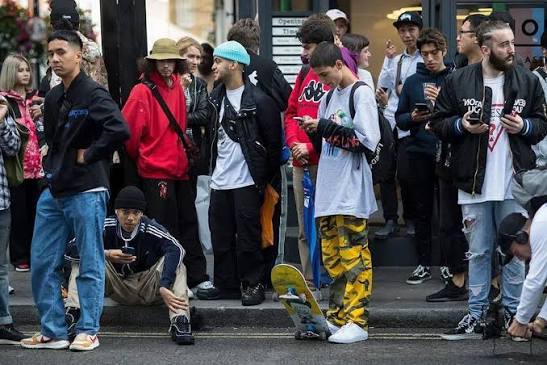
Image credit: 12lunes
Streetwear is a casual fashion movement rooted in 1980s skate and hip-hop subcultures that uses scarcity, graphic identity, and cultural credibility to turn everyday garments — tees, hoodies, sneakers — into status symbols. Defined by weekly limited “drops,” it emerged from Southern California and New York, was refined in Tokyo’s Ura-Hara district, and became a $200 billion influence on global luxury after 2018.
1. Streetwear, Defined — Beyond the “Casual Clothes” Cliché
Streetwear is an apparel distribution system that relies on intentional scarcity and subcultural signaling rather than traditional seasonal retail. To outsiders it looks like casual clothes with a logo. It isn’t. Slapping graphics on a blank tee doesn’t produce streetwear; it produces a t-shirt with graphics on it. The distinction is whether wearing the item proves you were somewhere, knew something, or waited in a specific line on a specific Thursday.
The category has, frankly, outgrown its own definition. Fashion executives now describe it less as a style and more as an “operating system” that luxury brands eventually adopted.
Understanding the category means separating it from the movements it sits next to:
| Category | Origin | Price Signal | Silhouette | Key Brands | Wearer Identity |
|---|---|---|---|---|---|
| Streetwear | Skate / Hip-hop | High (Scarcity) | Architectural / Oversized | Supreme, Stussy, Corteiz | Subculture insider |
| Athleisure | Yoga / Gym | Medium (Premium) | Fitted / Spandex | Lululemon, Alo Yoga | Wellness-focused |
| Luxury Casual | European Heritage | High (Materials) | Tailored comfort | Loro Piana, Zegna | Wealth preservation |
| Techwear/Gorpcore | Hiking / Military | Medium-High (R&D) | Functional / Utility | Arc’teryx, Salomon | Practicality / Performance |
2. The Dual Origin Story — Skate Beaches and Bronx Blocks
Most fashion glossaries credit the whole thing to Southern California surf culture. That’s half the story.
On the West Coast, Shawn Stussy started shaping surfboards in his Laguna Beach garage in 1980. He needed to promote them at trade shows, so around 1981 he began screen-printing his signature on white Hanes tees. By 1984 he’d partnered with Frank Sinatra Jr. to launch a real apparel line. What Stussy did — and this often gets flattened in the retellings — was port the graphic language of punk and new wave flyers onto beachwear. That template still runs the industry.
The East Coast story is a different animal entirely. In 1982, Daniel “Dapper Dan” Day opened a 24-hour boutique on 125th Street in Harlem. European luxury houses didn’t want black consumers as customers (this is documented, not editorial), so Dapper Dan printed unauthorized Gucci, Louis Vuitton, and MCM logos directly onto premium leather jackets and tracksuits. He dressed LL Cool J, Salt-N-Pepa, Mike Tyson. Real ones. The operation lasted exactly a decade before the luxury houses lawyered him into closure in 1992.
Dapper Dan invented luxury streetwear thirty years before Paris admitted it existed. Which is worth sitting with for a minute.
3. How Tokyo Became the Second Capital
The Americans invented the aesthetic. Japan invented the business.
In the early 1990s, the Ura-Harajuku district in Tokyo — Ura-Hara, if you want to sound like you know what you’re talking about — became a laboratory for youth fashion. The scene revolved around Hiroshi Fujiwara, a DJ and designer who acted as a cultural translator between London, New York, and Tokyo. His protégé Tomoaki Nagao (nicknamed “NIGO,” meaning “number two,” because he was Fujiwara’s number-two guy) launched A Bathing Ape in 1993. He opened a small shop called NOWHERE with Jun Takahashi of Undercover, and that’s where the machine got built.
The math is what matters. Nigo printed roughly 50 t-shirts a week. He gave 25 away to Tokyo’s influential creators and stylists — the exact people who’d photograph well wearing them — and put the other 25 on the racks. Supply met about 10% of demand. Not being able to buy the thing became the entire product. BAPE didn’t just create scarcity; it created the scarcity playbook, and every streetwear brand since is running some version of it.
4. The Economics of the Drop — Why a T-Shirt Costs $60 and Resells for $600
Streetwear is expensive because of scarcity, not fabric.
A typical heavyweight streetwear tee — a Bella+Canvas 3001 blank, or a custom cut-and-sew — costs $8 to $15 to manufacture and print. Brands retail these for $50 to $80, targeting a 40% to 50% margin. Standard rag trade economics. The magic isn’t in the garment; it’s in the release mechanism.
The drop model works like this: release a limited number of units at a specific time (traditionally Thursday morning EST, though some brands have moved to weekends), and never restock. Ever. This is the whole trick. Once the item sells out, secondary markets — StockX, Grailed, occasionally eBay for the older heads — take over.
Retail vs. Resale Comparison (Estimated Secondary Market Values)
- Supreme Box Logo Crewneck: Retail $158 | Resale $400–$500
- Supreme x MM6 Maison Margiela T-Shirt (2024): Retail $88 | Resale $139
- Limited Nike SB Dunk Low: Retail $130 | Resale $500–$1,000+
The brand only captures the initial $50 or $158 or whatever it is. That $300 markup on the secondary market is somebody else’s money. But it functions as marketing — nobody buys next season’s drop because of an ad. They buy it because they remember last season’s sold out in eight seconds and hit $500 on StockX by Sunday.
5. The Uniform — What You’ll Actually Find in a Streetwear Wardrobe
Silhouette shifts about once a decade. The 1990s: baggy denim, oversized sports jerseys. The 2010s: a hard, ugly pivot to skinny jeans and elongated tees (an era we don’t talk about). Late 2010s: back to oversized, drop-shoulder cuts.
By 2026, the word isn’t “baggy.” The word is “architectural.” Everything drapes with intent.
The 8-Piece Starter Vocabulary:
- The Heavyweight Hoodie: 450 to 550 GSM French terry or loopback fleece. Below 450 the fabric clings and looks cheap; above 550 you’re basically wearing a rug. This spec is non-negotiable in 2026.
- The Graphic Tee: Boxy fit, thick collar ribbing, often pigment-dyed for a vintage fade.
- Cargo Pants: Heavy cotton twill, pocket placement over pocket count. If it looks like a paintball uniform, it’s wrong.
- The Work Jacket: Cropped chore coats or canvas zip-ups.
- The Sneaker: A heritage court shoe (Nike Dunks, Jordan 1s) or a technical runner (Salomon, Asics).
- The Cap: Low-profile 5-panel or unstructured dad hat.
- The Tote Bag: Heavy canvas, heavily branded.
- The Technical Shell: Ripstop nylon windbreakers.
None of this is a rulebook. It’s the vocabulary. What you say with it is on you.
6. The Brand Landscape — From Cult Indie to LVMH-Owned
The industry breaks into four tiers.
- Foundational Pioneers: Stussy, Supreme, BAPE, Undercover. They wrote the rules.
- Contemporary Heavyweights: Kith, Palace, Fear of God, Aimé Leon Dore. Higher-volume retail, still gate-kept.
- Luxury Hybrids: Balenciaga, Dior Men, Louis Vuitton. Traditional houses that borrowed the silhouettes and the drop cadence.
- The Emerging Class: Corteiz, Trapstar. They reject traditional retail entirely.
The consolidation at the top is nearly finished. In October 2024, EssilorLuxottica — yes, the eyewear conglomerate — acquired Supreme from VF Corp for $1.5 billion in cash. Off-White, the brand that stitched streetwear to high fashion in the first place, went the other way. LVMH sold its 60% controlling stake to Bluestar Alliance, a brand management firm, in late 2024. Two of the biggest names in the category, both flipped in the same quarter. That’s not a coincidence.
7. The Virgil Abloh Inflection Point — When Streetwear Ate Luxury
2018 broke the timeline. LVMH appointed Virgil Abloh — founder of Off-White, a full product of the streetwear ecosystem — as menswear artistic director at Louis Vuitton. That appointment forced the establishment to admit what everyone under 35 already knew: streetwear wasn’t a youth subculture anymore, it was the dominant global aesthetic.
Abloh handed guests at his debut show a dictionary. It defined streetwear as a “predictable clothing genre in a renegade designer’s debut collection.” That’s a man who understood exactly what was happening.
The victory ate itself. Once the luxury houses swallowed the drop model, the counter-cultural edge dulled fast, and by late 2024 a Highsnobiety survey of 1,000 consumers found 56% felt less excited about streetwear than they had a few years earlier. LVMH’s Off-White sale to a licensing firm — a licensing firm — was the punctuation mark. When the parent company hands your brand to the people who manage the Tapout MMA license, the party is officially over.
8. Where Streetwear Is Going — The Gorpcore, Quiet Luxury, and Post-Logo Era
By 2026 the market has split in two, largely because the box-logo era looks embarrassing to anyone born after 2005.
The first branch is Gorpcore (from “Good Ol’ Raisins and Peanuts” — trail mix). Arc’teryx, Salomon, and the whole outdoor-technical crowd dominate here. Gore-Tex shells, waterproof zippers, and quiet utility are the new flex. This bleeds directly into Quiet Luxury, where materials do the talking instead of logos.
The second branch goes the opposite way: back to guerrilla exclusivity. Corteiz, out of London, is the clearest example. No traditional retail, no corporatized drop cadence. They do flash-mob pop-ups. In May 2026 the brand ran a heavily anticipated activation in Shibuya, Tokyo — coordinates dropped at the last minute, physical chaos on arrival, Japan-exclusive product only. The whole thing was designed to feel like the early Supreme era before it got institutional.
Corporate streetwear is cooling. Community-driven scarcity, run by twenty-somethings who don’t care about scaling, still commands full loyalty. Which is roughly where the story started in 1993 in a tiny shop in Ura-Hara, if you were paying attention.
FAQ Section
What’s the difference between streetwear and casual wear?
Casual wear is mass-produced clothing designed for comfort. Streetwear applies intentional scarcity, limited drops, and graphic branding to casual garments, turning them into cultural status symbols. The clothing itself often overlaps; the distribution model is what makes it streetwear.
Why is streetwear so expensive?
You’re paying for brand equity and the economics of the drop, not raw materials. A premium heavyweight hoodie costs somewhere in the $15 to $20 range to manufacture. Retail hits $80+, and once it sells out, secondary market prices can climb into the hundreds — occasionally over $1,000 for the right graphic or collab. None of that markup is fabric.
Is streetwear still relevant in 2026?
Yes, but it’s changed.
What’s the difference between streetwear and hypebeast culture?
Streetwear is the design movement rooted in skate and hip-hop history. “Hypebeast” refers specifically to the hyper-consumerist subculture of buying, hoarding, and reselling limited items for profit or status. Every streetwear brand needs hypebeasts to move product, but most people inside the culture would rather not be called one.
How do I start dressing in streetwear without looking like a poser?
Focus on staples, not logos. A 500-GSM heavyweight hoodie that actually drapes, canvas cargo pants that fit properly, and a pair of retro sneakers will get you further than a stack of box-logo tees. Silhouette does the work.