
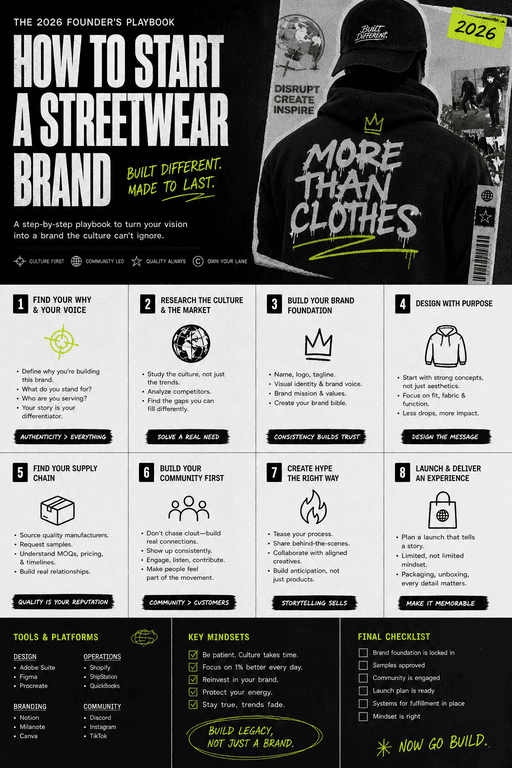
TL;DR: Starting a streetwear brand takes a clear point of view, somewhere between $500 and $15,000, and a validated audience before you ever place a bulk order. The founders who survive start with screen-print runs of 30 to 50 units, file trademarks early, and spend at least 60 days building community before the first drop. Most brands die around month 18, and it’s almost never because the designs were bad. It’s cash flow.
The Streetwear Brand Reality Check
The global streetwear market is projected to hit roughly $397.97 billion by 2026. Massive number. Meanwhile the apparel startup failure rate sits at 90%, with 30% of new brands closing inside 24 months.
Founders rarely fail because their designs are weak. They fail because they can’t read a bank statement. There’s a well-circulated postmortem on r/streetwearstartup from a founder going by Tensaga who documented a $30,000 CAD loss across a seven-year run. The core mistake: assuming sold-out drops meant guaranteed future demand, then bulk ordering across a dozen unproven SKUs at once.
Global data tells the same story. Small retail and apparel businesses that closed in 2026 carried an average of $61,000 in debt at shutdown, usually waiting until sales had already dropped more than 40% before pulling the plug.
Reality check: Skip this article if you’re chasing hype. Stay if you’re building a business. If you can’t afford to lose your initial investment, don’t buy bulk inventory.
Define a Point of View Before You Design Anything
Graphic design cannot fix a broken foundation.
The brands surviving past 24 months share one thing: a specific, describable point of view. Look at the tier below the giants. Aimé Leon Dore built an empire on 90s hip-hop nostalgia crossed with Queens prep. Corteiz weaponized London grit and closed-community access — you literally had to solve a puzzle to buy the pants. Story mfg. staked everything on slow fashion, natural dyes, and vintage outdoor silhouettes. In each case you can describe the target customer in five words.
Fill this out honestly:
My brand exists to give [subculture / specific audience] a way to express [emotional promise] through [visual language].
If your subculture is “everyone” or your visual language is “cool graphics,” you don’t have a brand yet. Close this tab and go talk to fifty people you want to sell to. Not five. Fifty.
The Founder’s Cost Sheet (What $500, $3K, and $15K Actually Buy You)
Most advice says you need $2,000 to $5,000 to start. That range is close to useless without context. Budget determines manufacturing constraints, and manufacturing constraints determine everything else.
You can technically start for $500 using print-on-demand, but $3,000 is the realistic floor for a brand with any staying power. $15,000 unlocks cut-and-sew with proper labeling.
| Budget Tier | Product Approach | Realistic First Drop Size | What You Can’t Afford Yet | Honest 12-Month Outcome |
|---|---|---|---|---|
| $500 | Print-on-Demand (POD) | 0 units (made to order) | Custom tags, bulk discounts, heavy marketing | Side hustle or hobby. Low margins ($15-$20 cost per hoodie) starve ad spend. |
| $3,000 | Local Screen Print + Premium Blanks | 30–50 units per style | Cut-and-sew custom silhouettes | Profitable local/niche brand. You hit the $4-$8 per unit print cost tier. |
| $15,000 | Full Cut-and-Sew / Overseas Direct | 100–300 units per style | Dedicated retail space | High-margin scaling operation ($8-$12 landed cost per hoodie). |
In the $3,000 tier your blank selection carries more weight than most founders realize. Los Angeles Apparel is a popular domestic choice, with wholesale tees running about $5.00 to $9.00 and hoodies starting around $10.00. For international consistency, the AS Colour Staple Tee (5001) and Heavy Tee Relaxed (5080) are still the industry benchmarks — pre-shrunk, OEKO-TEX certified. Obviously you’re not putting a 5001 next to a heavyweight silhouette and calling it a premium line, but as an entry blank it’s fine.
From Print-on-Demand to Cut-and-Sew — The Manufacturing Ladder
Streetwear manufacturing has four rungs. You don’t need to start at rung four.
Stage 1: Print-on-Demand (POD). Zero inventory. Platforms like Printful print on demand (DTG) when an order lands. A standard DTG hoodie costs you $15 to $20. No setup fees, but your gross margins will be brutal.
Stage 2: Local Screen Printing. Around 50 units you should graduate to a local print shop. Screen printing has setup fees of roughly $20 to $40 per color, but the per-unit print cost drops to $4 to $8.
Stage 3: Private Label (Overseas). You’re ordering 100+ units of premium blanks from overseas factories, custom neck labels, hangtags, the works. Landed hoodie cost drops into the $8 to $12 range.
Stage 4: Cut-and-Sew. Custom garments from raw fabric, built off a tech pack. US-based factories often enforce MOQs of 300+ units. With current tariff pressure on Chinese goods, a lot of 2026 brands are shifting to Vietnam and Turkey, where MOQs sit at a friendlier 100+ units. Some premium brands actually manufacture the base garment in Turkey and ship it to Italy for finishing so they can legally apply a “Made in Italy” tag. This is one of those things that gets whispered about at trade shows and never written down, but it’s extremely real.
When to move up a rung: Move to Stage 2 when you have $1,000 in cash. Move to Stage 3 when you consistently sell out 50-unit drops. Move to Stage 4 when your customer wants a silhouette a blank tee can’t give them.
The Legal Floor (Don’t Skip This, People Get Sued)
Three legal foundations, non-negotiable: a registered entity (an LLC gives you personal liability protection a sole proprietorship doesn’t), a clean trademark search, and strict distance from copyrighted IP.
Trademarks got more expensive in 2025. The USPTO raised the base application fee to $350 per class of goods. The bigger issue is a $200 surcharge per class if your custom identification of goods deviates from their ID Manual or exceeds 1,000 characters. Hiring an attorney to walk you through it runs $1,000 to $2,500.
Don’t parody Nike logos. Don’t lift unedited frames from anime or 90s films onto your blanks. Cease-and-desists arrive fast in 2026, and payment processors will freeze your funds the moment a verified DMCA complaint hits.
The Zero-Followers Launch Playbook
Posting graphics to an Instagram account with 14 followers is a waste of a Tuesday. Build demand before the product exists.
Standard email waitlists suffer massive drop-off, churning at 20% to 40% as promo emails get buried. Modern streetwear launches lean heavily on Discord to build tight, localized, high-engagement communities before a shirt is ever cut.
The 30-day pre-launch calendar:
- Days 1–10: Identify 30 to 50 micro-influencers — people with 2,000 to 5,000 engaged followers inside your exact subculture. Send free samples. No posting requirements. None.
- Days 11–20: Open a private Discord. Tease the drop on TikTok and Instagram, and make Discord entry the only way to get the pre-sale password.
- Days 21–30: Pitch two or three local boutique owners on consignment. Give them 30% of retail. Use their physical location as credibility for your online launch.
Drops vs. Seasonal vs. Always-On — Which Model Fits You
The drop model gets romanticized, but for undercapitalized founders it’s a cashflow trap. You pay for inventory weeks before revenue lands.
Pick based on capital, not vibes.
Drop model. Best for high-hype, low-capital brands. Order 50, sell out, roll the cash into 75. Protects against dead stock, caps your monthly revenue.
Seasonal model. Spring/Summer and Fall/Winter. Needs at least $10,000+ in working capital because money is locked in factory orders for months.
Always-on model. Core blanks — logo tee, hoodie — constantly in stock. Stabilizes cash flow. Requires heavy upfront capital to hold full sizing runs.
Pricing Without Bleeding Margin
Aim for the 25/20/15 split. For a healthy DTC apparel brand, 25% of retail covers COGS, 20% covers customer acquisition, and 15% covers logistics and fulfillment. That leaves you 40% gross margin.
Price to absorb the software tax. In 2026, Shopify Basic is $39/month ($29 annual). Using Shopify Payments you’re paying 2.9% + $0.30 per transaction. Try to use a third-party gateway on Basic and Shopify slaps on an extra 2.0%.
Pricing reality check: If your landed cost (garment + print + custom tag + freight) is $12, pricing that shirt at $25 will bankrupt you once you factor Shopify fees, poly mailers, and returns. A $12 landed cost needs a $40 to $45 retail to fund the next production run. This isn’t a suggestion.
The 18-Month Wall — Why Most Brands Die (and How to Not)
Streetwear brands don’t die in month one. They die between month 12 and month 18.
By month 18 the friends-and-family pity buys have stopped. Initial organic TikTok reach has flattened. If the whole thing was riding hype, the hype has cooled. This is the inflection point, and it’s the exact spot where founders fall into the inventory-in-the-garage trap. They assume the fifth drop will move like the first, order 200 units, sell 30, and run out of operating cash on a Wednesday afternoon.
The 18-month survival checklist:
- Never order bulk inventory off a single viral post.
- Shift attention from acquiring new customers to retaining your first 500 buyers.
- Move from blank tees to custom cut-and-sew that justifies higher price points.
- Track landed cost exactly — freight, duties, everything.
Hold discipline on MOQs. Refuse to scale production faster than the community grows. The brand survives.
FAQ
1. How much money do you actually need to start a streetwear brand?
You can start with $500 using print-on-demand to test designs, but the realistic floor for a brand holding actual inventory (30 to 50 screen-printed units) is $3,000. Full cut-and-sew closer to $15,000.
2. Do I need a tech pack to work with a manufacturer?
Yes, if you’re doing cut-and-sew. A tech pack is the blueprint — measurements, fabric specs, hardware. You do not need one if you’re just screen printing on blanks. This is the single most common question I get from founders who haven’t yet decided which rung of the manufacturing ladder they’re on, and the confusion usually stems from watching a YouTube video where someone shows off a beautiful 40-page tech pack for a graphic tee that literally didn’t need one. Match the document to the product. If you’re printing on a 5001, you need artwork files and a size run. That’s it.
3. Is Printful good enough to start with, or do I need a real manufacturer?
Printful is a testing ground. It kills upfront inventory risk but caps margin at $15-$20 per hoodie cost. Once you’ve sold 30+ units and validated demand, you have to move to local screen printing or overseas direct or the numbers will eat you.
4. How long before a streetwear brand becomes profitable?
Managing tight on a drop model, you can hit unit-economics profitability by drop two, roughly month 3 or 4. Replacing your day-job income usually takes 24 to 36 months of compounded community growth.