
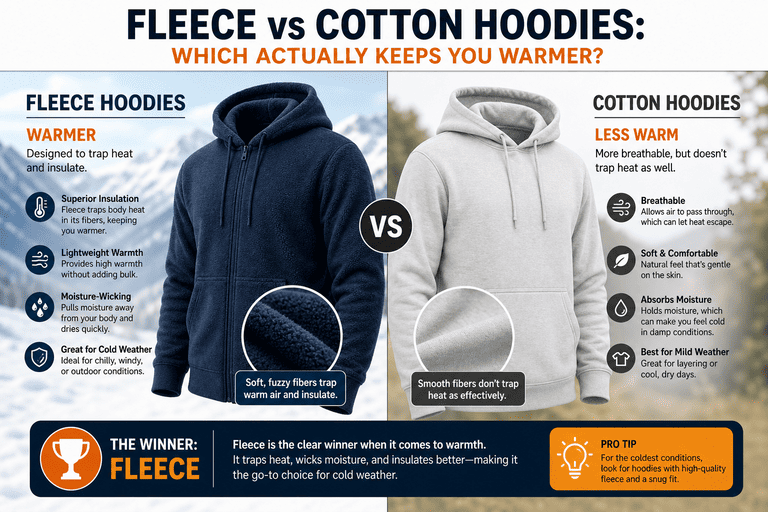
TL;DR: Polyester fleece hoodies are warmer than cotton hoodies at the same garment weight because fleece traps more air in its lofted structure. Cotton wins in specific cases: heavyweight cotton (400+ GSM) in dry conditions, or when breathability matters more than raw warmth. For cold-weather outdoor use, pick polyester fleece. For indoor comfort, or layering under a coat in mild weather, cotton is fine.
1. The Short Answer (and Why It’s Not the Whole Answer)
At equivalent weights, polyester fleece is warmer. A 250 GSM polyester fleece hoodie insulates better than a 250 GSM cotton hoodie because the fleece surface holds a thicker layer of static air. Textile lab measurements put 100% polyester fabric at roughly 0.04 W/m·K thermal conductivity, versus around 0.06 W/m·K for standard cotton. Lower number, less heat leaving your body.
The mechanism is structural, not chemical. Cotton knits used in a typical hoodie are packed tight, which leaves little room for the air pockets that actually do the insulating work. Polyester polar fleece, invented in 1979 by Malden Mills, gets mechanically brushed into a high-pile surface built specifically to hold air.
Cotton still wins in specific situations, though. A heavyweight cotton hoodie above 400 GSM has enough sheer density to block cold better than a thin 150 GSM fleece. And indoors at around 68°F, cotton’s breathability keeps you from getting clammy in a way fleece won’t.
Quick verdict:
- Polyester Fleece: Best for outdoor temps below 50°F (10°C), active use.
- Cotton: Best for indoor wear, dry weather, or heavyweight 400+ GSM utility applications.
2. Why Fleece Traps Heat Better — The Physics in Plain English
Insulation is about trapped air, not the fiber itself. Fleece manufacturers knit synthetic yarns and then run them through wire cylinders that break open the loops, creating that fuzzy, lofted surface full of microscopic air pockets. The air does the insulating. The 200 GSM polar fleece holds a thicker layer of dead air than a 200 GSM cotton jersey, even at identical weight.
Here’s the part that trips people up. Individual polyester fibers actually conduct heat faster than cotton fibers (0.14–0.20 W/m·K vs. 0.04–0.07 W/m·K). If you wore a solid sheet of polyester plastic, you’d freeze. But the finished fabric structure flips the outcome, because the lofted fleece as a whole comes in at 0.04 W/m·K while finished cotton sits at 0.06.
| Material | Individual Fiber Conductivity | Finished Fabric Conductivity |
|---|---|---|
| Cotton | 0.04 – 0.07 W/m·K | 0.06 W/m·K |
| Polyester Fleece | 0.14 – 0.20 W/m·K | 0.04 W/m·K |
Structure beats material. This is why “what’s it made of” is almost the wrong question.
3. When Cotton Actually Wins — Three Honest Scenarios
Scenario A: Indoor wear and light commutes. Cotton breathes. It moves moisture vapor off the body naturally, and at 70°F indoors or on a brisk walk to the train, a 250 GSM cotton hoodie won’t leave you with that swampy synthetic-fleece feel around the collar.
Scenario B: Radiant heat environments. This one matters more than most buying guides admit. Campfires, welding, anywhere sparks fly. Polyester is a petroleum product and it melts fast, and melted polyester fuses to skin. Cotton burns instead of melting. That’s a genuinely different safety profile.
Scenario C: Heavyweight class. A 400 GSM heavyweight cotton hoodie uses mass to block wind and cold. Premium streetwear and workwear brands have leaned into 400+ GSM cotton fleece in the last few years. It weighs on your shoulders, but it feels warmer than a wispy 150 GSM microfleece. Weight class sometimes trumps fiber type.
4. The Wet-Cotton Problem — Overhyped or Real?
Real. Not overhyped. Cotton has a natural moisture regain of 7.0% to 8.5%, meaning water actually enters the cell walls of the fiber. Polyester is hydrophobic, sitting at about 0.4% regain.
Once cotton is wet, its insulation collapses. Wet garments can lose up to 90% of their thermal efficiency, because water conducts heat much faster than air does. A soaked cotton hoodie pulls heat off your core, fast.
Dry times widen the gap. Polyester dries in 30 to 60 minutes at ambient temperature. Saturated cotton takes 4 to 6 hours to dry through. Not great for backcountry use. For a coffee run in a light drizzle, honestly, whatever you own is fine.
| Activity | Wetness Risk | Recommended Fabric |
|---|---|---|
| Gym warmup | High (sweat) | Polyester fleece |
| Couch lounging | Low | Cotton |
| Mild drizzle walk | Moderate (rain) | Polyester fleece |
5. Reading the Label — GSM, Weight, and What “Fleece” Actually Means
“Cotton fleece” usually means cotton loopback or French terry, not polar fleece. This is where brands love to muddy the water. Polar fleece is fully synthetic, made from polyethylene terephthalate (PET). Cotton fleece is 100% cotton brushed on the inside to raise the nap. It feels fuzzy in the hand, but it does not have the warmth-to-weight ratio of synthetic polar fleece. Not close.
GSM (grams per square meter) tells you the weight bracket.
- Lightweight (150–250 GSM): Thin, breathable, summer layering or tropical climates.
- Midweight (250–350 GSM): The industry standard. This is where most brand-name hoodies live. Fine for typical fall.
- Heavyweight (400+ GSM): Thick, structured. Premium streetwear and cold-weather workwear.
Check the materials tag. If it says 100% cotton, it will not perform like a synthetic outdoor layer, regardless of what the marketing page calls it. I’ve watched people spend two hundred bucks on a “fleece” hoodie that turned out to be brushed cotton, and they didn’t figure it out until they got rained on.
6. How Each Fabric Behaves in a Layering System
Cold-weather dressing works as a system, not a garment. The standard three-layer setup: base layer to wick sweat, mid-layer for insulation, outer shell for weather. Every outdoor retailer’s layering guide says the same thing: never wear cotton as a base layer. It absorbs sweat and traps cold moisture against your skin the moment you stop moving.
A polyester fleece hoodie makes a good mid-layer. Over a synthetic base, under a shell, it insulates without soaking up the condensation building on the inside of your jacket.
A cotton hoodie as a mid-layer under a rain shell is where people get themselves in trouble. The shell doesn’t breathe well, cotton grabs the evaporating sweat, you stop moving at the summit, and suddenly you’re wearing a wet sponge. The temperature drop can be brutal.
7. Everything Else That Isn’t Warmth — Quick Decision Factors
Durability isn’t close on paper. Polyester tests at 30,000 to 45,000 Martindale abrasion cycles. Cotton lasts 8,000 to 12,000. But friction makes synthetic fleece pill, and cotton softens with age in a way fleece never will. Different failure modes, take your pick.
Environmental math cuts both ways. Growing 1 kilogram of cotton takes roughly 10,000 liters of water. Producing 1 kilogram of polyester takes around 70. That’s a big gap.
But fleece sheds microplastics like it’s the whole point. A single wash can release up to 900,000 microfibers into wastewater. And recent lab work found that recycled polyester fleece shed 55% more microplastics during washing than virgin polyester, which is not the direction anyone wanted that number to go.
| Attribute | Cotton | Polyester Fleece | Winner |
|---|---|---|---|
| Shrink resistance | Low (up to 5%) | High | Polyester |
| Pilling resistance | Moderate | Low | Cotton |
| Water footprint | 10,000L per kg | 70L per kg | Polyester |
| Microplastic shedding | None | High (up to 900k/wash) | Cotton |
I’ll admit I still tend to reach for cotton for everyday stuff even after seeing the water numbers. Habit, mostly. Not defensible.
8. The Buying Decision — Match Fabric to Use Case
Match the material to the activity, not the other way around. A 250 GSM polyester fleece for athletic warmups, damp fall hikes, or as a mid-layer under a shell. A 300 GSM cotton hoodie for dry fall days, working from home, sitting around a fire pit where a spark might land on you.
Hybrid options exist for people who want serious warmth without a plastic exterior. Sherpa-lined cotton hoodies pair a heavy cotton outer with a thick polyester sherpa inside — cotton feel, synthetic loft. Carhartt’s Rain Defender Heavyweight Sweatshirt is the reference point here, and there are plenty of cheaper knockoffs that do the same thing structurally. Bonded polyester sherpa on a 100% cotton shell. Warmer than pure cotton can manage on its own, without the shiny synthetic hand.
If you’re only going to own one, get the fleece. If you’re going to own two, the second one is cotton.
FAQ
1. Are fleece hoodies warmer than cotton hoodies?
Yes. Fleece traps more air in its brushed loops, giving it a lower thermal conductivity (0.04 W/m·K) than cotton (0.06 W/m·K). At the same weight, fleece retains body heat noticeably better.
2. What is the warmest hoodie material overall?
Sherpa-lined hybrids (cotton exterior, heavy polyester sherpa interior) or heavyweight 400+ GSM polyester fleece top the list for hoodie-format garments. Wool insulates beautifully too, but you rarely see it in casual hoodie construction — it’s expensive to knit at hoodie weight and it doesn’t drape the way people expect a hoodie to drape.
3. Is cotton or fleece better in the rain?
Fleece, and it isn’t close. Polyester is hydrophobic and only absorbs about 0.4% of its weight in moisture. Cotton absorbs up to 8.5% and loses roughly 90% of its thermal efficiency once wet.
4. What GSM makes a hoodie warm?
Midweight warmth starts around 250 GSM. Heavyweight starts at 400.
5. Is “cotton fleece” the same as regular fleece?
No. Cotton fleece is usually loopback or French terry brushed on the inside. Regular polar fleece is 100% polyester. They feel similar in the store. They behave very differently in weather.