
In the global textile and garment manufacturing industry, precision is the language of quality. For brand owners, designers, and procurement managers, one of the most frequent technical hurdles is navigating the different units of measurement used for fabric weight. While Asian and European factories typically operate using the metric system (GSM), the North American and UK markets often rely on the imperial system (Ounces).
Understanding how to convert GSM to Oz is not merely a mathematical exercise; it is a critical step in ensuring that your custom apparel meets the specific “hand-feel” and durability requirements of your target market.
GSM stands for Grams per Square Meter. It is a metric measurement of the fabric’s density. Essentially, it tells you how much a one-meter by one-meter square of the fabric weighs.
In the world of custom hoodies, GSM is the primary indicator of warmth and thickness.
Lightweight (150–200 GSM): Typically used for high-quality T-shirts or summer-weight base layers.
Medium-weight (240–300 GSM): The standard for traditional sweatshirts and light hoodies.
Heavyweight (350–500+ GSM): The gold standard for modern streetwear. These fabrics provide the “boxy” structure and premium “drape” that high-end brands demand.
In the United States, fabric weight is traditionally measured in ounces per square yard (oz/yd²), often shortened simply to “ounces” or “oz.” This unit measures how many ounces a square yard (36 inches by 36 inches) of fabric weighs.
Because a square yard is smaller than a square meter ($1 \text{ m}^2 \approx 1.196 \text{ yd}^2$), the numerical value in ounces is always significantly lower than the GSM value. This is where most communication errors occur during the OEM manufacturing process. A client requesting a “10 oz hoodie” is actually asking for a very heavy garment (approx. 340 GSM), whereas a novice might confuse “10 oz” with a much lighter fabric if they don’t understand the conversion.
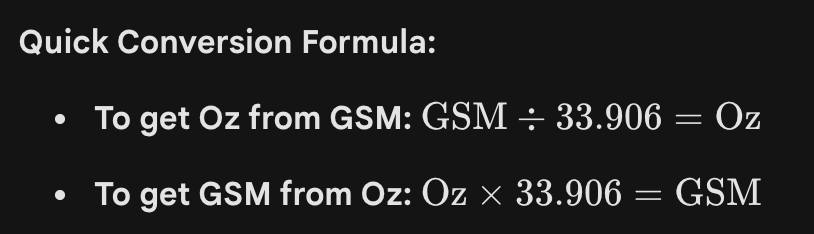
To accurately convert GSM to oz sq yard, the magic number is 33.906.
To get Oz from GSM: $\text{GSM} \div 33.906 = \text{Oz}$
To get GSM from Oz: $\text{Oz} \times 33.906 = \text{GSM}$
“Note: While 33.906 is the mathematical constant, in our factory, we always perform physical weighing of fabric swatches to account for dye-lot variations, as darker dyes can slightly increase the GSM of the final hoodie fabric.”
Using a Fabric Weight Converter ensures that your tech packs are technically sound. For instance, if you are sourcing a 14 oz “Super Heavyweight” fleece for a luxury collection, our tool will instantly tell you that you need to request at least 475 GSM from your Chinese supplier.
The weight of the fabric dictates the final silhouette of the garment. At HoodieOEM, we categorize fit based on these weight classes:
Heavyweight fabrics (above 380 GSM / 11.2 oz) have high structural integrity. They don’t “cling” to the body; instead, they hold their own shape. This is essential for the “dropped shoulder” look prevalent in contemporary fashion. If the fabric is too light, the shoulders will collapse, losing the intended aesthetic.
Medium-weight fabrics (250–300 GSM / 7.4–8.8 oz) are the workhorses of the apparel world. They offer a balance of breathability and warmth, making them ideal for year-round layering. When choosing a weight for a global market, this “mid-tier” is often the safest and most commercially viable option.
Generally, higher GSM fabrics are more durable and resistant to pilling, provided the yarn quality is high (such as Combed Cotton). For brands positioned in the “Slow Fashion” or “Luxury Streetwear” space, opting for a heavier ounce count is a signal of quality to the end consumer.
One common mistake is assuming that weight equals quality. While a GSM to Oz converter gives you the weight, it doesn’t tell you the “composition.”
Fleece vs. French Terry: Two fabrics can have the exact same GSM, but a brushed fleece will feel much thicker and warmer than a flat-knit French Terry.
Shrinkage Factors: Heavyweight 100% cotton fabrics can shrink more than polyester blends. Always account for a 3-5% variance in weight after the first wash-and-dry cycle.
In the competitive landscape of clothing manufacturing, being “roughly right” isn’t good enough. Whether you are translating a tech pack from a US designer for a factory in Dongguan or trying to compare price points between different fabric suppliers, using a dedicated Oz to GSM converter is essential.
By mastering the relationship between these two units, you gain better control over your product development, reduce sampling errors, and ultimately deliver a product that meets your customers’ expectations for fit, feel, and function.
At HoodieOEM, we provide these tools to empower our clients. Use our interactive calculator above to ensure your next custom collection is built on a foundation of technical accuracy.