
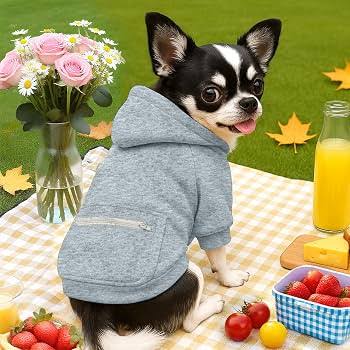
Designing a custom dog hoodie comes down to five decisions: measure your dog standing square, pick fabric for the climate and the coat type, choose a cut that matches the dog’s build, plan closures and harness access, and prototype before you cut into anything you care about. The step people skip is almost always the 6-point fit test. This guide is aimed at craft-literate owners, Etsy sellers, and small pet-brand founders who want something that actually fits a real dog instead of a mythical medium Beagle.
Why Off-the-Rack Fails — Mapping Your Dog’s Actual Shape
Dogs are not scaled-down humans, and more importantly, most dogs are not scaled versions of each other. The pet apparel industry builds mass-market patterns around a generic medium-proportioned dog, roughly Beagle-shaped, and that assumption breaks the moment you try to dress one of the three real-world archetypes.
Deep-chested breeds like Greyhounds and Dobermans have a chest-to-waist ratio that can approach 2:1. A generic hoodie that fits their 30-inch chest will hang off an 18-inch waist like a sail, funneling cold air straight down the belly. Long-backed breeds — Dachshunds, Corgis — need back length extensions in the 20-30% range over standard patterns. Stocky-square breeds like English Bulldogs and Pugs have broad shoulders and thick necks, and a hoodie that fits their back length will choke them at the collar.
Figure out which bucket your dog falls into before you touch a tape measure. Call it Step 0. You cannot force a square pattern onto a deep-chested dog without pinning their shoulders.
Step 1 — The 7-Point Measurement Protocol
A proper fit needs seven measurements, not three. Most tutorials ask for neck, chest, back length and stop there. Professional pet tailors use seven points so the finished garment doesn’t fight the dog’s gait.
Measure the dog standing square — all four legs planted, head in a neutral position. A sitting dog’s back lengthens, and if you measure them that way, you’ll end up with a hoodie that drapes past the tail. For double-coated breeds, measure over the coat as it naturally sits. Do not cinch the tape against the skin; you’re dressing the dog you have, not the shaved version.
| Measurement | Where to Measure | What it Controls |
|---|---|---|
| 1. Neck Base | The widest part of the lower neck, resting on the shoulders. | Prevents choking when the dog lowers its head to sniff. |
| 2. Chest Girth | The widest point of the ribcage, directly behind the front elbows. | Determines the primary size and prevents shoulder binding. |
| 3. Back Length | From the base of the neck (withers) to the base of the tail. | Controls hem placement and rear coverage. |
| 4. Belly Girth | The narrowest part of the waist, in front of the hind legs. | Ensures a draft-free fit on deep-chested breeds. |
| 5. Front Leg Girth | Circumference of the upper front leg. | Dictates armhole size and sleeve width. |
| 6. Rear Clearance | Distance from the last rib to the hind leg joint. | Prevents the fabric from restricting the squatting motion. |
| 7. Sleeve Length | From the shoulder joint down to the desired cuff point. | Keeps the fabric above the dewclaw to prevent tripping. |
Step 2 — Choosing Fabric Without Cooking Your Dog
This is the section I’d fight an editor over, so I’m going to spend a minute on it. The right fabric depends on outdoor temperature, coat density, and activity level, in roughly that order. But the thing most people get wrong isn’t the choice between fleece weights — it’s forgetting that dogs don’t sweat through their skin. They dump heat by panting and through merocrine glands in their paw pads. Wrap a dog in heavy fabric and you’re closing the exits.
Brachycephalic breeds — Pugs, French Bulldogs, English Bulldogs — have Brachycephalic Obstructive Airway Syndrome baked into the skull shape. Their airways are already compromised at rest. Heavy fleece on a Pug indoors isn’t an aesthetic choice, it’s a heat-stroke risk, and this is the thing I will die on a hill about. If your Pug “needs” a sweater for the Instagram photo, use a cotton jersey and take it off after the shot. Full stop.
The other common error runs the opposite direction. Heavy double-coated breeds — Huskies, Malamutes, most of the northern working breeds — rarely need a hoodie at all. If you’re putting one on a Husky, it’s usually just to contain shed hair in the house, and a lightweight cotton jersey is plenty. Anything thicker is you dressing the dog for yourself.
For actual warmth, microfleece in the 150-200 GSM range insulates without turning the dog into a baked potato. Polar fleece at 250-300 GSM belongs on single-coated dogs — Whippets, Pitbulls, that body type — and really only below 40°F. French terry, usually a cotton-poly blend, is my default for fall walking weather on active dogs. It breathes, it has decent stretch recovery, and it doesn’t soak up water like straight cotton does.
| Fabric Type | Weight (GSM) | Best For | Avoid For |
|---|---|---|---|
| Cotton Jersey | 120-160 | Indoor wear, keeping shedding contained | Extreme cold |
| French Terry | 200-250 | Fall weather, active walking | Heavy rain (absorbs water) |
| Microfleece | 150-200 | Dry winter days, single-coated breeds | Double-coated breeds |
| Polar Fleece | 250-300 | Freezing temps, Greyhounds/Whippets | Brachycephalic breeds |
One honest caveat: I still default to French terry even for warmer-than-fall weather on my own dogs, because I grew up sewing with it and I trust how it behaves on the machine. That’s habit, not a defensible fabric-science argument, and if you push me on it I’ll admit a lightweight jersey would probably perform better above 60°F.
Step 3 — Choosing a Cut That Matches Your Dog’s Build
Four cuts cover most of what you’ll actually sew: pullover, zip-front, step-in, and the vest-hoodie hybrid.
The pullover is the standard human-style hoodie and requires bending the front legs through the armholes. Fine on a flexible young dog, miserable on an arthritic senior. Zip-fronts put the zipper along the chest or back and skip the leg-bending entirely. Step-ins fasten along the back, usually with Velcro or snaps, and are the right call for stocky breeds like Bulldogs where the head-through-collar approach just doesn’t work. The vest-hoodie hybrid drops the sleeves and gives you maximum shoulder mobility, which is why it’s the usual starting point for deep-chested breeds.
If you’re grading a commercial pattern like Simplicity 8804, apply the archetype logic. For a Dachshund, slice horizontally across the mid-back and add 20-30% in length without touching the chest girth. For a Greyhound, bump the chest girth by 15% and taper the belly girth down by 20% to match the tuck-up. Obviously you wouldn’t apply both at once.
Step 4 — Engineering the Functional Details
A functional dog hoodie needs four engineered details: a reinforced leash slit, properly placed leg cuffs, correct belly clearance, and a hood actually shaped for a canine skull. Skip these and you’ve built a hazard with a logo on it.
If the dog wears a harness under the hoodie, you need a slit. A raw cut will tear the first time the leash goes taut. Reinforce the opening with a bound buttonhole or a welt opening, the same construction you’d see on a suit jacket pocket. Place it vertically between the shoulder blades for a back-clip harness.
Belly clearance is sex-dependent. A male dog’s hoodie has to curve up sharply toward the ribs to clear the prepuce during urination, and the male cut typically runs 2-4 inches shorter along the underbelly than a female cut, depending on size. This is one of those details that nobody tells you about until you’ve sold a hoodie to someone and gotten the email.
Leg openings should use ribbed knit cuffs, not tight elastic. Elastic restricts blood flow and snags on dewclaws. The hood itself is mostly aesthetic — most dogs will shake it off within a block — but if you want it functional, pattern it to accommodate the ears with slits or a wide gusset, and keep it cut high enough over the eyes that it doesn’t block peripheral vision.
Step 5 — Prototype, Fit-Test, Then Produce
Do not cut into your final fabric without a prototype. Build a mockup in muslin, or in cheap scrap fleece that approximates the stretch of your production material. Put it on the dog and run the 6-point fit test.
- Sit Test: Does the neck base choke when the dog sits?
- Lie Down Test: Do the front legs pull inside the armholes at rest?
- Squat Test: Take the dog outside. Can they urinate and defecate without soiling the fabric?
- Gait Test: Walk them at a brisk pace. Watch the shoulders. If the fabric bunches or alters their stride, armholes are too small.
- Head Turn Test: Can the dog look over their shoulder without the hoodie torquing sideways?
- 20-Minute Heat Check: Leave the prototype on indoors for twenty minutes. Panting, pacing, or the dog seeking out cold tile means your fabric is too heavy.
Pass all six, then cut your final.
If You’re Outsourcing — How to Brief a Custom Maker or POD Service
If you’re not sewing it yourself, you’ve got two paths: Print-On-Demand or a custom tailor.
For POD like Printful, you design inside their constraints. Their All-Over Print Pet Hoodie runs a 95% polyester, 5% spandex blend at roughly 250 g/m² (about 7.47 oz/yd², though POD catalogs update often enough that I’d check the live spec sheet before you commit). Submit artwork as high-res PNG or JPEG, generally 150-300 DPI. POD platforms use generic sizing, so you still need to lay their size chart next to your 7-point measurements before you promise anything to a customer.
For a custom tailor on Etsy or a local maker, send a simplified tech pack:
- Flat sketch of the hoodie: front, back, underbelly.
- Your dog’s 7-point measurements.
- A photo of the dog standing square so the tailor can see the archetype.
- Specific callouts — for example, “Add 3-inch welt opening for harness clip at the withers.”
- Fabric preference and color hex codes if you care about matching.
Costing It Out — DIY vs POD vs Custom Tailor
Production method sets the price. DIY is cheapest per unit if you ignore the value of your own time. Anti-pill fleece from a craft store runs roughly $10-$15 per yard and a hoodie uses less than a yard for most dogs.
POD is the hands-off path for sellers. Printify base cost on a pet hoodie lands somewhere in the $17-$22 range depending on size and print provider, though your actual number shifts with subscription tier and material pricing. To make the math work on Shopify or Etsy after shipping and platform fees, you’re pricing retail around $35-$45.
Bespoke tailors are where you go when the dog doesn’t fit anything else. Custom-tailored hoodies on Etsy ballpark $45-$85, which reflects the labor of drafting a one-off pattern to your measurements.
| Production Method | Estimated Unit Cost | Time Investment | Best For |
|---|---|---|---|
| DIY (Materials Only) | $10 – $20 | High (3-5 hours) | Hobbyists, exact custom fits |
| Print-On-Demand | $17 – $25 (Base) | Low (Design time only) | E-commerce brands, standard breeds |
| Custom Tailor | $45 – $85 | Low (Measuring time only) | Hard-to-fit breeds, non-sewers |
FAQ
How do I measure a dog that won’t stand still?
Get a second person to hold a high-value treat — peanut butter on a spoon works — at nose level. Keeps the head neutral and the body square long enough to get through the 7 points.
Is it safe for my dog to wear a hoodie indoors?
Depends on breed and fabric. Single-coated dogs with low body fat, like Whippets, are generally fine in lightweight cotton or microfleece indoors. Double-coated and brachycephalic dogs should not wear hoodies indoors. Overheating risk is real and it builds faster than people expect, especially in a heated room where the dog can’t find a cool surface. Pugs and Frenchies are the ones to watch closely; if you see hard panting within the first ten minutes, pull it off.
Can I use a human baby hoodie pattern as a starting point?
No. Different shoulder mechanics, different chest-to-back ratio. It will bind the front legs and sag at the belly.
How do I add a leash hole without weakening the fabric?
Don’t just cut a slit. Use a bound buttonhole or sew a welt opening, and reinforce both ends with bar tacks (tight zigzag) to absorb leash tension.
What’s the cheapest way to prototype before buying expensive fabric?
A yard of muslin, or an old fleece jacket from a thrift store. Match the stretch percentage of your final fabric as closely as you can, because stretch is what decides whether the fit translates.