
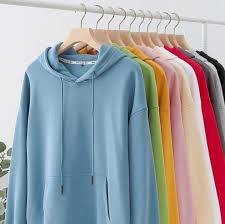
French terry is best for breathable, midweight, premium-feeling hoodies, while fleece is best for warm, cozy, cold-weather hoodies. Hoodie brands should choose French terry for year-round streetwear, athleisure, and garment-dyed styles, and fleece for winter drops, loungewear, merch, and customers who prioritize softness and warmth.
The Difference Is Inside the Fabric, Not the Name
French terry is a knit fabric with a smooth outer face and looped inner surface, while fleece is usually brushed on the inside to create a soft, fuzzy texture that traps warmth. That inside face changes breathability, insulation, bulk, and how the hoodie feels after repeated wear.
Both fabrics start on circular knitting machines, often using the exact same face yarns. The split happens during finishing. French terry is left unbrushed, so the inside keeps its small yarn loops. Fleece is passed over spinning cylindrical brushes that tear and split those internal loops into a fuzzy pile.
Because “fleece” and “French terry” refer to knit construction rather than fiber content, both can be made from 100% cotton, 100% polyester, or a blend like the industry standard 80/20 cotton-poly mix. Manufacturers classify standard French terry weights between 240 and 380 GSM (grams per square meter), while standard cotton fleece ranges from 280 to 500 GSM.
Structural Comparison:
- Inner face: French terry has distinct yarn loops; fleece has brushed, broken fibers.
- Outer face: Smooth knit surface on both.
- Air retention: Fleece traps high amounts of dead air in the brushed pile; French terry allows more airflow through the loops.
- Typical feel: Fleece feels plush right away. French terry feels firmer, sometimes even a little stiff until it breaks in.
Choose French Terry When Your Hoodie Needs Breathability and Structure
French terry works best for apparel lines selling into mild climates or transitional seasons. According to production data, French terry wearability is optimal at 60-80°F (15-27°C). The unbrushed loops absorb moisture rather than trapping heat, so the fabric breathes better than brushed fleece.
Brands aiming for a clean, structural drape often land here. Heavyweight French terry, often reaching 400 to 600 GSM, has become a standard for premium custom streetwear brands that want a durable, luxury feel without cooking the wearer indoors. Because the interior is not brushed, the fabric keeps its shape and density wash after wash. I still lean toward French terry for more year-round programs even when fleece would photograph softer on a product page, which is not always the most commercial instinct, but it saves a lot of arguments after the third wash.
Best for:
- Spring/fall hoodie drops
- Premium streetwear focusing on heavy structure
- Gym warmups and athleisure
- Garment-dyed collections
- Customers in the US South, Australia, and the Middle East
Choose Fleece When Warmth and Softness Sell the Product
Fleece dominates the winter apparel market because its brushed interior traps air and gives the wearer that immediate plush feel. Production specs place optimal fleece wearability at 30-65°F (-1 to 18°C). Customers who want softness before anything else usually prefer fleece over the firmer hand of loopback terry.
Fiber blend dictates how the fleece performs over time. A 100% cotton fleece offers a premium natural hand feel and high breathability, but it carries a higher risk of shrinking. A 100% polyester fleece is highly insulating, lightweight, and dries quickly, though it lacks a premium fashion aesthetic. Blends, particularly the 80/20 cotton-poly ratio, stabilize the fabric to prevent shrinkage while retaining a soft interior.
Comparison of Fleece Fibers:
- Cotton fleece: Softer natural feel, heavier drape, shrinks 5-10% if not pre-treated.
- Cotton-poly fleece: Better shape retention, cost-efficient, standard for merch.
- Polyester fleece: Lightweight, highly insulating, fast-drying, often used for performance outdoor gear.
GSM Changes the Decision More Than Most Fabric Comparisons Admit
GSM can matter more than the fabric name because it measures fabric weight and strongly affects warmth, drape, cost, and perceived quality. A heavyweight French terry can feel more premium than a lightweight fleece, while a high-GSM fleece may be too warm for year-round hoodie collections. Never compare French terry and fleece unless the GSM is similar or clearly disclosed.
Diminishing returns kick in hard above the mid-range of 350 GSM. A standard fast-fashion hoodie sits around 280 GSM. Premium streetwear hoodies in 2026 typically range from 350 to 450 GSM. Ultra-heavyweight models, like the 1ABEL Side B Hoodie, use a massive 550 GSM cotton fleece that drapes heavily and costs $195 at retail.
Scaling fabric weight indefinitely creates its own problems. Moving past 650 GSM makes the hoodie uncomfortable to wear indoors and dramatically increases international shipping costs due to the raw weight of the garment. The spec can look impressive and still be wrong for the customer.
| Hoodie Goal | Possible GSM Range | Better Starting Fabric | Why |
|---|---|---|---|
| Lightweight spring hoodie | 220–280 GSM | French terry | Breathable, less bulky |
| Year-round premium hoodie | 350–450 GSM | Heavy French terry | Dense structure, minimal overheating |
| Winter lounge hoodie | 350–500 GSM | Cotton Fleece | Maximum softness and insulation |
| Low-cost merch hoodie | 260–320 GSM | Cotton-poly fleece | Cost-efficient, high availability |
Printing, Embroidery, and Garment Dyeing Can Decide the Winner
For printed hoodies, the smoother and more stable fabric face usually matters more than whether the inside is French terry or fleece. French terry often works well for clean prints and garment dyeing, while fleece can print well if the outer face is smooth and the fabric is tested after washing.
Screen printers and Direct-to-Garment (DTG) decorators prefer French terry for fine graphical details. Its flat, unbrushed interior creates a flatter overall canvas, preventing the garment from shifting under the press. Fleece can challenge fine print details because of its thick, compressible pile, but it can support heavy embroidery well. The brushed bulk helps keep high thread-count patches and puff prints from warping the fabric.
Garment dyeing is where the casual fabric conversation usually falls apart. Knit fabrics shrink aggressively during the high-heat dye process. The industry standard tolerance for garment-dyed cotton is 3-5% shrinkage. Brands running garment dye programs typically favor 100% cotton French terry over poly-blends because polyester does not absorb reactive dyes properly, leading to uneven colors. I know the clean sourcing answer is “test every construction equally,” and yes, do that, but for reactive dyed, 100% cotton programs I would rather start with French terry and make fleece prove it belongs there, especially if the fit is already oversized and the length-versus-width shrinkage starts pulling the garment in two directions, which is the sort of issue that looks minor on a spec sheet and obvious once the hoodie is on a body.
| Decoration Method | French Terry | Fleece | What to Verify with Supplier |
|---|---|---|---|
| Screen print | Excellent on smooth face | Good on smooth face | Print adhesion after washing |
| DTG | Best results with 100% cotton | Cotton face required | Pretreatment compatibility |
| Embroidery | Requires good stabilizer | Excellent due to thick pile | Tension puckering |
| Garment dye | Ideal (if 100% cotton) | Risky (polyester resists dye) | 3-5% shrinkage tolerance |
| Heat transfer | Flat surface prevents shifting | Compressible pile may shift | Press heat sensitivity |
Customer Perception: “Premium” Does Not Always Mean “Softest”
Customers judge hoodie quality by softness, weight, shape, and durability. A fleece hoodie often wins at first touch because the brushed inside feels plush on a hanger or in a fit video. French terry tends to win later, after the garment has been worn, washed, and pulled out of the drawer again. On the streetwear community subreddit r/streetwearstartup, brand founders routinely note that 80/20 poly-fleece interiors start out incredibly soft but begin pilling and losing their texture after repeated washes. In contrast, 100% cotton French terry actually softens and breaks in over time without shedding. That is not as easy to sell in a product description. It is easier to sell “soft.” It is harder to sell “this will still feel respectable after your customer stops treating it carefully,” though that is usually the point.
If a factory uses low-quality yarn, a fleece hoodie will quickly generate visible pills, those small balls of entangled fibers, under the arms. Buyers sourcing on Alibaba report that cheap 260 GSM fleece pills within ten washes. To prevent this, professional brands request lab tests verifying anti-pilling performance against the ISO 12945 or ASTM D4970 standards. And yes, I still ask for ISO 12945 before ASTM D4970 when the supplier seems vague, not because one line in a checklist magically fixes bad yarn, but because a factory that cannot answer the pilling-test question usually cannot answer the next three questions either.
The awkward part is that “premium” has become shorthand for several different things at once. Some customers mean soft. Some mean heavy. Some mean the hood stands up, the rib does not bag out, and the body does not twist after washing. A 500 GSM fleece can feel premium in the hand and still be too hot for the customer’s actual climate; a 320 GSM French terry can feel less impressive in a sample room and still sell better through summer evenings. This is why I do not like judging hoodie fabric by first touch alone, even though, if I am being honest, I still do it for the first five seconds like everyone else.
| Customer Complaint | Possible Fabric Cause | How to Prevent It |
|---|---|---|
| “Too thin” | Low GSM (under 280) | Specify 350+ GSM for premium feel |
| “Too hot” | Heavy fleece in a mild climate | Switch to 320 GSM French terry |
| “Pills quickly” | Low-quality poly-fleece | Request ISO 12945 pilling test |
| “Lost shape” | Untreated cotton shrinking | Use sanforized (pre-shrunk) fabric |
| “Feels cheap” | Rough interior poly blend | Compare wash-tested samples |
Cost, Margin, and Seasonality: The Business Side of Fabric Choice
Fabric choice directly dictates retail pricing and margin. French terry is typically 10-20% more expensive per meter than a comparable GSM fleece. The added cost comes from the dense knitting required to form clean, uniform loops without relying on brushing to create bulk.
The global hoodie market hit $199.2 billion in 2024, with fleece representing the fastest-growing segment at a 7.8% CAGR. This volume is driven by cost efficiency; cotton-poly fleece blanks offer accessible unit costs for merch drops and startup brands. Heavyweight fabrics (450+ GSM) command higher retail prices but incur much higher dimensional shipping weights, reducing margins on international orders.
Seasonality also limits inventory. A 500 GSM fleece hoodie will stop selling in May. A 320 GSM French terry hoodie can sell consistently in July as a summer evening layer.
| Brand Type | Better Starting Point | Reason |
|---|---|---|
| Premium streetwear | Heavy French terry | Structure and wash durability |
| Winter loungewear | Cotton fleece | Immediate soft hand feel |
| Gym / athleisure | Midweight French terry | Moisture absorption |
| Creator merch | Cotton-poly fleece | Cost efficiency at scale |
| Resort / travel brand | French terry | Wearable in 70°F (21°C) weather |
| Kidswear | Midweight fleece | Coziness and stretch |
Supplier Checklist Before You Approve a Hoodie Fabric
Never commit to a bulk fabric order based on a digital spec sheet. Untreated cotton fleece can shrink between 5% and 10% on its first home wash, which destroys carefully engineered oversized silhouettes. Suppliers must confirm they are using sanforized (pre-shrunk) fabric to keep shrinkage below 5%. Send this checklist to your manufacturing partner before approving production.
Sourcing Checklist for Factories:
- Exact fiber composition, not just “cotton blend” — for example, 100% combed cotton.
- Request the exact GSM and the acceptable tolerance range (+/- 10 GSM).
- Ask if the fabric is sanforized or compacted for shrinkage control.
- Vertical and horizontal shrinkage percentage after wash. It must be <5%.
- Ask for lab test results for pilling resistance (ISO 12945 or ASTM D4970).
- Confirm the dyeing method (reactive dyed, pigment dyed, or piece dyed).
- Run a print or embroidery test on the actual production lot, not just a generic swatch.
- Wash the decorated sample three times before measuring final dimensions.
Red Flags from Suppliers:
- Refusal to state the exact GSM.
- No shrinkage tolerance provided in the spec sheet.
- The sample fabric feels drastically different from the bulk fabric lot.
- Suggesting 100% polyester for a premium streetwear program.
Quick Recommendation by Hoodie Brand Type
Hoodie brands looking for sustainable alternatives can find identical performance in verified eco-materials. Suppliers like Yinsai Textile offer French terry using GOTS-certified organic cotton or GRS-certified recycled polyester, allowing brands to maintain technical specs while supporting eco-conscious claims.
| If Your Brand Is… | Choose… | Why |
|---|---|---|
| Premium streetwear | 450+ GSM French terry | Heavy, structured drape that holds shape |
| Fitness / athleisure | 280 GSM French terry | Absorbs sweat without overheating |
| Winter lounge brand | 350+ GSM Cotton fleece | Traps dead air for maximum insulation |
| Budget merch brand | 280 GSM Cotton-poly fleece | Broad supplier availability and low unit cost |
| Eco-conscious basics | GOTS Organic French terry | Verified material trace without chemical brushing |
| Warm-climate brand | 280 GSM French terry | Allows airflow for Mediterranean or Southern US markets |
| Cold-climate brand | 400 GSM Fleece | Retains heat in sub-50°F (10°C) weather |
Final Verdict: French Terry for Versatility, Fleece for Warmth
French terry is the safer default for versatile, breathable, year-round hoodie collections; fleece is the safer default for warm, soft, winter-focused hoodies. Hoodie brands should sample both at comparable GSM, wash-test them, and choose based on customer climate, decoration method, and retail price.
Comparing a 280 GSM fleece to a 500 GSM French terry will give you bad data. Order samples of both fabrics at 350 GSM. Wash them three times. Note the shrinkage, check the underarms for pilling, and evaluate how the chest accepts your screen print or embroidery. The fabric that survives that stress test is the correct choice for your brand.
FAQ Section
1. Is French terry or fleece better for hoodies?
French terry is better for breathable, structured, year-round hoodies; fleece is better for warm, soft, cold-weather hoodies. The final choice depends on your GSM targets, fiber blend, and whether your customers live in a warm or cold climate.
2. Is French terry warmer than fleece?
Usually no. Fleece is warmer because its brushed interior traps more air. However, a 500 GSM heavyweight French terry will feel warmer and more substantial than a 260 GSM lightweight fleece. Always compare GSM and construction together.
3. Is French terry good for a premium hoodie brand?
Yes. French terry is an excellent option for premium hoodie brands because it offers structure, high breathability, and a clean hand feel that softens over time. Many luxury streetwear brands default to 450+ GSM French terry for their core collections, but the better move is still to sample by GSM rather than assuming “French terry” automatically means premium. A weak 280 GSM French terry will not behave like a 450+ GSM core hoodie just because the product page uses the same fabric name.
4. Does fleece pill more than French terry?
Fleece can pill more quickly, especially lower-quality poly-fleece blends. The brushing process weakens the internal fibers, allowing them to entangle into small balls through friction. High-quality cotton French terry avoids this issue because the loops remain intact.
5. Which fabric is better for printing hoodies?
Both can work, but a smooth, stable fabric face matters more than the interior. French terry often provides a flatter, cleaner surface for DTG and screen printing, while thick fleece is exceptionally good at holding the tension of heavy embroidery.
6. What GSM should a hoodie brand choose?
Lightweight hoodies require 220–280 GSM, standard midweight hoodies sit between 300 and 350 GSM, and premium heavyweight hoodies demand 400 to 550 GSM. Climate and target retail price decide the range.