
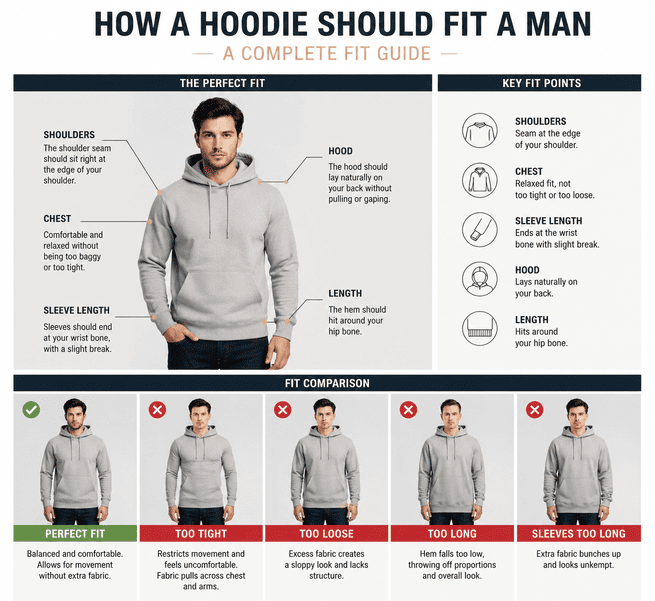
A men’s hoodie fits correctly when the shoulder seam sits at the edge of the shoulder, sleeves end at the wrist bone with about half an inch of slack at the cuff, the hem falls between mid-fly and mid-zipper, and you can pinch one to two inches of fabric at the chest. Body type, fabric weight, and what you’re actually using the thing for will move those targets around.
The 5-Point Hoodie Fit Map
Five zones decide whether a hoodie reads as well-fitted or sloppy. Most guys check one — usually chest — and call it a day. That’s how you end up with a hoodie that feels fine in the dressing room and looks wrong in every photo afterward.
- Shoulder Seam. The seam sits at the natural edge of your shoulder bone. If it’s climbing toward your collarbone, the armholes will dig in. If it’s sliding down your bicep on a standard cut (not drop-shoulder, those are different), you’ve got a tent.
- Chest Width. Pinch one to two inches at your side. Zero pinch is too tight; three-plus is too loose. This is the single most reliable fit test in menswear and it takes two seconds.
- Sleeve Length. Cuff at the wrist bone with arms hanging. When you raise your arms, expect it to ride up to mid-forearm — that’s normal, not a sizing problem.
- Hem Length. Ribbed hem hits somewhere between hip bone and mid-fly. Above the belt line is crop territory. Below the zipper makes your legs look short.
- Hood Drape. Lies flat against the upper back when down. When up, it should frame your face without strangling your neck or collapsing into your eyebrows.
Where the Shoulder Seam Should Actually Land
Shoulder is the one measurement you can’t fix later. You can hem sleeves, you can shorten a body, you can take in the waist on a zip-up. You cannot meaningfully alter shoulder width without rebuilding the garment, which is more expensive than just buying a hoodie that fits.
On a standard set-in sleeve, the seam aligns with the outer edge of your shoulder bone. Stand sideways in front of a mirror and the vertical seam line should track right down your deltoid edge.
Drop-shoulder construction throws this rule out on purpose. Streetwear cuts push the seam two to two and a half inches down the arm to create that relaxed drape across the upper torso. The test is different: the seam should sit evenly across the upper bicep. If it’s pulling diagonally across your chest, the cut is fighting your frame.
The mistake people make is buying a standard-cut hoodie two sizes up to chase the oversized look. The seam ends up in no-man’s-land — too far from the shoulder to read as fitted, not engineered for the drop-shoulder drape — and the result is just a bad-fitting hoodie pretending to be fashionable.
The Chest, Torso, and the Pinch Test
Measure pit-to-pit while the hoodie is flat on a table. If the size chart gives you a circumference, double that flat measurement.
The pinch test is what actually matters once it’s on your body. Pull the fabric outward from your side. One to two inches of excess is the standard fit window. Less than an inch and the hoodie clings; more than two and a half and it’s billowing.
| Cut Type | Pinch Test | Best Application |
|---|---|---|
| Athletic / Slim | 0.5 – 1.0 in | Layering under jackets |
| Regular / Classic | 1.0 – 2.0 in | Everyday wear |
| Relaxed / Drop | 2.5 – 3.5 in | Streetwear silhouettes |
If the chest is tight but the waist bags out, the cut is wrong for your body — not a sizing problem. The fabric should fall straight down from the armpits to the hem. Any taper or flare is a pattern issue.
Sleeve Length, Cuffs, and the Thumb-Hook Question
This is where I’m going to spend some time, because sleeves are where most hoodies get ruined and most guides skip past it in two sentences.
Hoodie sleeves run a touch longer than dress shirt sleeves — call it half an inch to an inch — to account for the ribbed cuff and the fact that you’re going to be moving your arms around in ways you wouldn’t in a button-up. The sleeve should end at the wrist bone when your arms hang at your sides. The cuff itself can stretch over the back of your hand a little, and that’s fine.
Watch for stacking. That’s the technical term for the folds of fabric that pile up just above the cuff. One or two small folds is normal — it’s how a sleeve is supposed to sit. Accordion-style stacking up the forearm means the sleeve is genuinely too long, and no amount of pushing it up is going to fix the silhouette. If the cuff swallows your hand entirely, the proportion is wrong and you’re in the wrong size.
Cotton shrinks. Specifically, cotton-fleece blends shrink in the vertical direction when you put them through a hot dryer, and your sleeves can lose close to an inch of length the first time you do it. This is why a hoodie that fit perfectly off the shelf can feel like a three-quarter sleeve six weeks later. The other direction of the problem: cuffs stretch out when you push your sleeves up the forearm. After a few months of habitual sleeve-pushing, the ribbing loses its memory and just hangs there.
You can shrink a stretched cuff back temporarily by soaking it in hot water and tossing it in the dryer on high, but it’s a bandage, not a fix. The permanent solution is cutting the cuff off, riding the sleeve up an inch, and serging a new one — and obviously you wouldn’t do that yourself unless you’ve got a serger and know how to handle ribbing.
The thumb-hook question: thumbholes are a personal taste thing. They keep the sleeve anchored at the wrist, which is useful in cold weather and for layering. They also stretch out the cuff faster than anything else. I don’t have strong feelings either way, except that a thumbhole on a 220 GSM hoodie is going to look sad inside of a year.
Hem Length — The Mid-Fly Rule
The ribbed hem should fall between the mid-fly and the mid-zipper of your pants.
Above the belt line, you’ve got a crop top — fabric rides up and exposes your shirt or skin every time you raise your arms. Below the crotch line, you’re shortening your legs and breaking the vertical line of the body. Both look wrong, in different ways.
Exceptions: streetwear has a tucking trend where you take a slightly oversized hoodie and roll the hem up under itself so the kangaroo pocket ruches forward. This creates a fake-cropped, boxy effect on purpose. Long-line hoodies are their own category — they drop to mid-thigh deliberately, but they need to be paired with slim or tapered legwear to balance the volume up top. Wear a long-line hoodie with baggy pants and you look like you got dressed in the dark.
The Hood Itself
Most guides skip the hood. The hood is half the garment.
A standard hoodie has a single-layer hood. Single-layer hoods don’t have the weight to hold their shape, so when you pull them down they collapse onto the back of your neck like a deflated balloon. Functional, but not great-looking.
Premium construction uses a double-layer hood — two complete hood patterns sewn together. The doubled fabric creates internal tension, which gives you a hood that actually stands up on its own. When you wear it up, it frames your face without sagging into your eyes. When you wear it down, it drapes on your back like a structured jacket collar instead of crumpling.
The tradeoff is weight. A double-layer hood at around 800 GSM combined adds real mass — the full garment can run close to 1.4 kg. That weight pulls the back of the hoodie down and slightly backward, which means the front collar has to sit a touch higher to compensate. This is why heavyweight hoodies fit weirdly in the neck if the brand didn’t pattern for it.
Fit by Body Type
Broad shoulders / V-taper. Size to the shoulder, not the waist. If you go down for the waist, the armholes will cut in and the chest will pull. Live with the extra room at the bottom or get it taken in.
Slim or lean build. Skip the heavy drop-shoulder stuff. Excess width at the shoulders just makes a lean frame look smaller. Stick with set-in sleeves and a slimmer cut — structure helps here.
Larger midsection. Heavier fabric drapes better over a bigger middle than a lightweight knit, which clings. Loopback terry or stiff fleece falls cleanly. The thing to avoid is an aggressive ribbed hem that cinches under the stomach — it cups the gut instead of skimming over it.
Tall (6’2″+). Standard hoodies run roughly two inches short in the body for tall guys. The hem ends up at the belt line, the sleeves are three-quarter, and the seams take more mechanical stress. Look for actual tall sizing — not just a size up, which adds chest width you don’t need. The hem still has to hit mid-fly when you’re standing.
Fabric Weight Changes Everything
Hoodie weight is measured in GSM — grams per square meter. The same exact pattern in two different fabric weights will fit like two different garments.
- Lightweight (220–300 GSM). Drapes close to the body. A 250 GSM hoodie in your normal size reads slim and almost tailored. Usually single-layer hoods. Best for layering under outerwear.
- Midweight (300–400 GSM). Industry standard. Reigning Champ’s midweight terry sits around 390 GSM, which is close to the sweet spot for daily wear — flexible enough to move in, structured enough to hold shape.
- Heavyweight (400–800 GSM). Stiff, boxy, armor-like. Heritage brands like Champion’s reverse weave run around 12 ounces, which is roughly 400 GSM. The 800 GSM stuff from high-end streetwear is double-layer construction — two layers of 400 GSM bonded together.
Heavyweight fabric doesn’t stretch. A 600 GSM hoodie in your “true size” will feel restrictive at the chest because the thick material doesn’t give the way a midweight does. And if you’re buying 100% cotton heritage construction, factor in vertical shrinkage from the first hot wash. It’s not subtle.
| GSM Range | Silhouette | Best Application |
|---|---|---|
| 220–300 | Close, fluid drape | Under a denim or leather jacket |
| 300–400 | Balanced structure | Everyday standalone wear |
| 400–800 | Boxy, stiff | Winter outerwear, streetwear |
Fit by Purpose
Different jobs, different hoodies. One garment will not do everything well.
Gym. Athletic cut, pinch test capped at one inch, sleeves ending right at the wrist for grip clearance. Cotton-poly blends with some moisture management beat pure cotton here.
Layering under a jacket. Lightweight or midweight, fitted profile, single-layer hood. A double-layer hood under a leather jacket creates a giant lump at the back of the neck and disrupts the coat’s collar.
Streetwear / oversized. Drop shoulder, longer torso, wider chest, hem riding higher to offset the bigger sleeves. The proportions are deliberately exaggerated and have to all move together — half-oversized doesn’t work.
Lounge. Whatever feels good. Brushed fleece, loopback terry. You can size up one for maximum comfort, but staying true to size is the difference between looking relaxed on a video call and looking like you just woke up.
FAQ
Should a hoodie be tight or loose?
Loose enough to pinch one to two inches at the chest, tight enough that the shoulder seams stay on the shoulder bone (unless you’re specifically buying drop-shoulder).
Should I size up or size down?
True to size for almost everything. Size up only if you’re buying 100% cotton that will shrink, or a heavyweight 400+ GSM hoodie with no stretch. Size down if you specifically want a base layer under a tailored jacket and you need it slim enough not to bulk out the coat. The “always size up in hoodies” advice you see on Reddit is wrong about half the time and depends entirely on the fabric.
Where should the bottom of a hoodie fall?
Between mid-fly and mid-zipper. Higher and it crops; lower and it shortens your legs.
How do I know if a hoodie is too small?
Three signs: you can’t pinch at least an inch at the chest, the cuffs sit above your wrist bone with your arms hanging, or the hood pulls tight against your throat when you put it up.
Is it OK if the shoulder seam sits past my shoulder?
Yeah, if it’s drop-shoulder.