
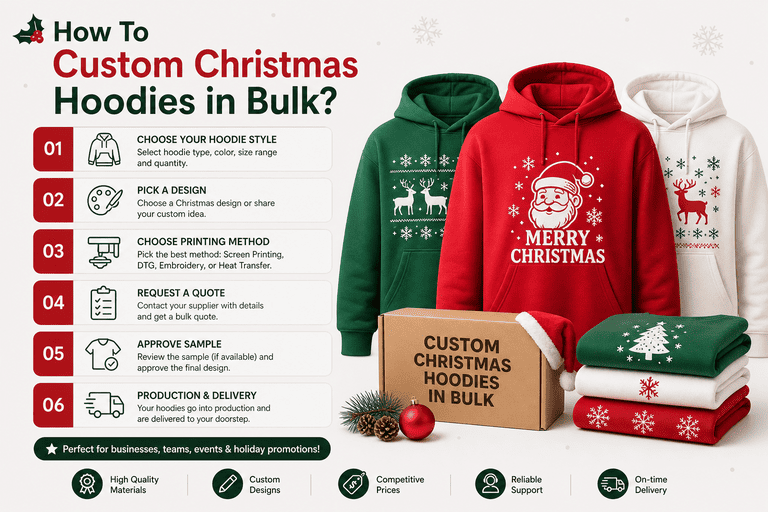
TL;DR: To order custom Christmas hoodies in bulk, lock in three things at least 4–6 weeks before December 25: print method, order quantity, and blank selection. Standard production takes 15–20 business days after artwork approval. For anything over 48 units, screen printing on an 80/20 cotton-poly blank is almost always the right call.
The Backward Timeline: When You Actually Need to Order
For guaranteed delivery by December 25, place standard bulk hoodie orders 4–6 weeks in advance. Rush orders no later than 2 weeks out, and even then you’re rolling the dice.
Most buyers assume the clock starts when they pay. It doesn’t. Production begins after you formally approve the digital mockup, and mockup revisions eat 3 to 5 days on their own if you’re picky (and you should be picky). Standard production runs 15 to 20 business days after that approval.
Working backward from December 25:
- Mid-November (6 weeks out): Submit artwork and finalize order details.
- Late November (4 weeks out): Absolute deadline to approve mockups for standard domestic production.
- December 10 (2 weeks out): Deadline for local rush orders. Expect a 20–50% rush surcharge and whatever blanks the printer still has in the warehouse, which is rarely the blank you actually wanted.
- Early November (8 weeks out): Cutoff for overseas manufacturing. Factories need 15–30 days for bulk production, plus 7–12 days for air freight, and that’s assuming customs behaves.
If you’re reading this after Thanksgiving and you haven’t started, you’re already in rush-fee territory. Call, don’t email.
Choosing the Right Printing Method for Fleece (Not T-Shirts)
Screen printing is the most durable and cost-effective method for bulk Christmas hoodies over 24 units. DTG and embroidery serve smaller runs and premium finishes respectively.
Hoodie fleece behaves differently than t-shirt cotton, and a lot of decorators still learn this the hard way. Heavyweight fabrics in the 350–500 GSM range hold stitches and plastisol ink beautifully, but the fuzzy face disrupts digital printing.
- Screen Printing: Plastisol sits on top of the fleece. Bold colors, heavy opacity, 100+ washes without meaningful fade. The catch is setup cost — you generally need 12 to 24 units minimum to offset burning screens.
- Direct-to-Film (DTF): Good for complex, full-color designs. Prints onto PET film, then heat-presses onto the garment. DTF holds up around 50+ washes and carries zero setup fees. Large solid designs can feel thick and rubbery on the chest, though. Wear a DTF hoodie for an afternoon and you’ll notice.
- Direct-to-Garment (DTG): Sprays water-based ink into the fabric. DTG struggles on dark 50/50 cotton-poly hoodies because the polyester dye migrates into the white ink during curing. You want a 100% cotton face, or at minimum an 80/20 blend, for clean DTG results.
- Embroidery: Highest perceived value. Heavy fleece is a stable foundation for needlework and doesn’t pucker the way thin jersey does.
MOQ Tiers and Where the Price Actually Breaks
The real price break for custom hoodies typically happens at 48 units, and again at 144, where setup fees stop dominating per-unit cost.
Vendors love advertising hoodies “as low as $18.” That rate assumes you’re buying a couple hundred units of a Gildan blank with a one-color left-chest print. It is not the number you’ll see on your quote. Bulk pricing sits on rigid volume tiers, most commonly breaking at 12, 24, 48, 72, and 144.
- Tier 1 (12–23 units): Baseline. Expect $30 to $50 per hoodie.
- Tier 2 (24–47 units): Volume discounts begin. Costs drop 10–15%.
- Tier 3 (48–71 units): First major price break. Costs drop 15–25% compared to baseline.
- Tier 4 (144+ units): Wholesale kicks in. Per-unit drops 35–45%.
Always check your final count before paying. If you need 45 hoodies, bump it to 48 — the three extra units frequently cost nothing on paper and might lower the total invoice. I’ve had jobs where adding units to the order made it cheaper. Buyers don’t believe me until they see the requote.
Blank Selection — Fleece Weight, Blend, and Fit
Retail-quality hoodies need a heavier fabric weight (GSM or ounces) and a high cotton-to-polyester ratio to absorb ink properly.
Not all blanks perform well under a heated press or in actual winter weather. Fabric weight determines warmth; blend determines printability. 80/20 cotton-poly is the industry default for balancing ink absorption against shrink.
- Gildan 18500 (Budget Workhorse): 8 oz, 50/50 cotton-poly. The standard promotional hoodie. Blanks run about $21 CAD. Fine for a family reunion or a giveaway. Won’t feel like anything you’d buy at retail.
- Independent Trading Co. SS4500 (Mid-Tier Standard): 8.5 oz, 80/20 ring-spun. Around $30.95 CAD blank. Cotton face takes screen printing flawlessly. This is what I default to when a client says “make it feel nice but don’t blow the budget.”
- Bella+Canvas 3719 (Retail Premium): Lightweight 6.5 oz sponge fleece, 52/48 blend. Around $33.95 CAD. Modern fitted cut, side seams so it won’t twist after a wash.
- Streetwear Heavyweights: 400–500 GSM French terry or brushed fleece, usually with a boxy drop-shoulder fit.
If you’re building a brand you actually want people to wear voluntarily, don’t start with the 18500. I’ve watched too many small brands do that and wonder why nobody’s posting photos in the merch.
Designing Christmas Artwork That Prints Cleanly
Christmas designs fail on press more often than any other seasonal category, because glitter inks, fine snowflake lines, and dark garments demand contradictory screen configurations.
The Metallic and Glitter Trap. Metallic silver, gold, and glitter inks need large particles to reflect light, which means low mesh screens, typically 30 to 86 thread count. Fine detail — thin typography, delicate snowflake tips — cannot pass through coarse mesh. It just drops out. You end up with a snowflake that looks like a blob. If your holiday design is heavy on metallic ink AND fine linework, one of those has to give.
Zippers and Seams. Never print solid designs across a hoodie zipper with plastisol. The ink pools in the gap and cracks the first time someone unzips it. If you absolutely have to print across the zipper, spec 100% cotton and use water-based discharge ink.
Red-on-Black Dye Migration. Printing white or red ink onto a dark 50/50 poly-blend hoodie often results in dye migration — the poly dye bleeds under curing heat and turns your white ink pink or grey. Fix with a blocker base, or spec a 100% cotton-face blank. This is the #1 reason “why did my hoodies come back looking weird” tickets exist.
The Sample Order — What to Actually Inspect
Ordering a sample prevents a 144-unit disaster. When the sample arrives, don’t stand in front of a mirror. Do structural tests.
- Stress the seams. Firm pressure on the armholes and pocket corners. Premium hoodies use 4-needle 6-thread flatlock stitching, which handles heavy stretching without failing.
- Check dimensional tolerance. Measure sleeve lengths and collar placement. Variance greater than 5mm counts as a manufacturing defect in luxury apparel, and honestly you should hold your midrange supplier to the same number.
- Crock test. Rub a white cotton cloth firmly against the print and the dyed fabric. Heavy transfer means poor colorfastness. This is a 30-second test and I don’t know why more buyers skip it.
- Pilling. Rub the fleece face aggressively, or just run it through a normal wash. Cheap polyester pills fast.
I still spec titanium-tipped needles for embroidery samples even when the shop tells me it’s overkill on standard cotton — old habit from a bad batch years ago, not really justified anymore.
Hidden Costs Nobody Warns You About
Base quotes rarely equal the final invoice. Shops offset low per-unit pricing by stacking setup fees at checkout, and buyers who don’t ask about them get surprised.
- Digitizing: Embroidery machines can’t read a JPEG. Converting art to stitch paths costs $20–$50 for a standard logo, plus $2–$6 per unit based on stitch count. A chest logo averages 5,000–15,000 stitches.
- Sample fees: Producing a single physical sample means halting a bulk production line to make one hoodie. $30–$60 per style is standard.
- Rush fees: 7-day turnarounds usually add 20–50% to the invoice.
- Freight: Overseas air runs $6–$12 per kilo. Sea freight is $1–$3 per kilo but adds weeks to the delivery window.
Ask for a fully-loaded quote up front. If a supplier can’t give you one, that tells you something.
Choosing a Supplier — Local, Nationwide, or Overseas
Your supplier choice dictates minimum order, production speed, and how much QC leverage you actually have.
- Local Screen Printers: 7–10 day turnarounds, hands-on QC, no shipping cost. Per-unit is higher than the online volume shops, but if something goes wrong you can walk in the door.
- National Platforms (Custom Ink, Printful, etc.): Reliable for hitting exact dates. Low minimums via DTG. Prices scale badly past 100 units compared to wholesale.
- Overseas Manufacturers: Best economics on 300+ unit orders — landed costs for custom heavy fleece run $18–$30 per unit. Tradeoff is speed and communication. Order by early November to survive 15–30 day production cycles and customs. If you’ve never done overseas before, don’t start with your Christmas order.
FAQ
What’s the cheapest way to make 100 custom Christmas hoodies?
Gildan 18500 blanks, one-color screen print, single location (front chest). Keeping the design to one color kills the extra screen setup fees. You’ll land somewhere around $15–$20 per unit.
How late can I order custom Christmas hoodies and still get them by Dec 25?
For standard production, artwork approval needs to be in by late November — that’s 4 weeks out. The hard cutoff is December 10, but you’re paying a local printer’s rush rate, eating whatever blanks they have on hand, and shipping overnight. It’s doable. It’s not fun. And every year I get at least one client who calls me on December 12 and I have to tell them the answer is no.
Is screen printing or embroidery better for Christmas hoodie designs?
Screen print for large, detailed graphics. Embroidery for small logos and clean, premium finishes. Embroidery will not do gradients and it will absolutely butcher a fine snowflake.
Can I order custom hoodies with different designs but as one bulk order?
Usually no. Bulk tiers depend on fixed setup costs, and in screen printing every design change means burning a new set of screens. Mix garment colors and sizes to hit a tier — the artwork has to stay the same.