
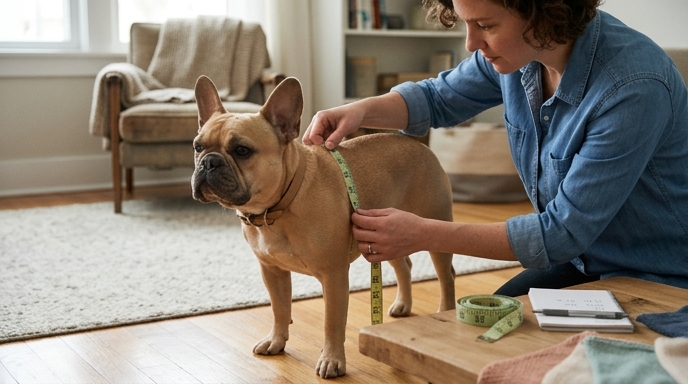
To measure a French Bulldog for a custom hoodie, you need four numbers off a soft tape: chest girth at the widest point behind the front legs, neck circumference at the collar line, back length from base of neck to tail base, and shoulder-to-shoulder width. When you land between sizes, round up.
Why Frenchies Break Standard Dog Sizing Charts
French Bulldogs don’t fit generic small-breed sizing charts, and the math is pretty simple once you see it. The AKC breed standard caps Frenchie weight at 28 pounds, which drops them into the “small dog” bucket on most charts. But their bone density and barrel chest produce a silhouette nothing like a 20-pound Boston Terrier or a Jack Russell at the same weight.
Here’s where it falls apart. A standard small-breed hoodie built for a 20-pound dog usually accommodates a 17 to 19-inch chest. A 20-pound Frenchie frequently measures 22 inches around. So if you buy the generic size that actually fits their chest, the back length ends up around 16 inches or more, draping over the tail and getting in the way of the back legs. Fit problems account for the majority of pet apparel returns (I’ve seen numbers north of 60%, though the exact figure depends on who’s counting), and barrel-chested breeds skew that number badly.
The Four Measurements That Actually Matter
Chest girth, neck circumference, back length, shoulder width. That’s the list.
- Chest Girth: The make-or-break number. Measure the absolute widest part of the ribcage, directly behind the front legs. Not under the armpits. Behind them.
- Neck Circumference: At the base of the neck, where it meets the shoulders. Hoodies need a wider neck opening than a plain shirt because the hood itself adds fabric bulk at that seam.
- Back Length: From the base of the neck to the base of the tail. Frenchies have short backs — usually somewhere in the 11 to 13-inch range for a typical adult, though longer-backed pet lines can push past that.
- Shoulder Width: Straight across the front chest, from the outside of one shoulder joint to the other. Frenchie shoulders bow outward and carry real muscle. Narrow armholes will chafe the pits within one walk.
Step-by-Step: Taking Each Measurement Without a Wrestling Match
You need a calm dog and a soft tailor’s tape. The plastic kind from a sewing kit works fine; the stiff metal contractor tape does not.
- Stand the dog up. Always measure standing squarely on all fours. Sitting curves the spine and expands the ribcage, and you can lose or gain an inch or two on the chest number without realizing it.
- Measure the chest. Wrap around the widest part of the ribcage. The old “two-finger rule” (slide two fingers under the tape before you read the number) applies if you’re ordering non-stretch material like heavy fleece. For spandex blends and stretch knits, take the exact skin-tight measurement and trust the fabric to do its job.
- Measure the neck. Collar off. Wrap around the thickest part of the lower neck, right where the collar normally sits.
- Measure the back. Zero at the base of the neck, pull straight back to the exact point where the tail begins.
Measure after a walk, when they’re tired and less inclined to spin. Take each number twice and average them.
Reading a Custom Hoodie Size Chart (and What to Do When You’re Between Sizes)
When your Frenchie’s numbers fall between sizes on a hoodie chart, chest girth decides. Everything else can be fudged a little; chest girth cannot. If the chest doesn’t fit, the hoodie doesn’t go on the dog.
Cross-reference against the specific seller’s chart, not a general one. SparkPaws, for example, lists a Large for a 20-22 inch chest and an XL for a 23-24 inch chest. If your Frenchie measures exactly 22.5 inches, you’re in no-man’s-land.
For pullovers, round up to the XL. Pullovers need extra clearance to get over the skull and the bat ears, which are not small. For zip-ups, also round up. Zippers have zero horizontal stretch, and a tight zip-up compresses the chest. On a brachycephalic breed that is already working harder than most dogs just to breathe, that’s not a trade-off worth making for a cleaner silhouette.
Puppy, Adult, or In-Between: Timing Your Custom Order
Frenchies hit roughly 80% of their adult height by 9 to 12 months, but they are not done. The chest keeps broadening and filling out until somewhere around 18 to 24 months.
Which means ordering a perfectly fitted custom hoodie for a 6-month-old is throwing money away. They’ll outgrow the chest within a couple months. For anything under a year, buy cheap stretch-heavy generic apparel and save the custom orders for after the skeletal structure settles.
Body Type Matters: Sizing for Pear-Shaped vs. Apple-Shaped Frenchies
Not every Frenchie has the same build. Show-line dogs tend to hold a leaner, more compact frame near the 28-pound standard. Pet-line Frenchies regularly push past 30 pounds and distribute that weight differently.
Vets use the WSAVA Body Condition Score, a 1-to-9 scale where a 4 or 5 is ideal. For sizing purposes:
- Apple-Shaped (BCS 7-9): Weight carried in the chest and neck. Prioritize chest girth above everything else and expect the back length to run a little long on them.
- Pear-Shaped: Narrower chest, thick hips and thighs. If the maker gives you a bottom-hem measurement, make sure it clears the waistline, or the hoodie will roll up the back every time the dog moves.
I still spec a slightly roomier chest than the chart says for apple-shaped dogs, even on stretch fabric. Old habit from the shop, not strictly justified.
Common Measurement Mistakes That Cause Returns
The complaint I see over and over on the Frenchie subreddits is “fits the body, cuts into the armpits.” Almost always traces back to one of three errors:
- Measuring too far forward. If you measure under the armpits instead of behind them at the widest part of the ribcage, the hoodie gaps at the belly and pulls tight across the shoulders.
- Measuring over a collar. A thick collar adds an inch or two to the neck number. The finished hoodie sags off the shoulders and slides back along the spine.
- Using a rigid ruler or metal tape. You end up with straight-line gaps between tape and dog, which inflates the chest number by as much as 3 inches. The result is a sack the dog can walk out of.
Before You Hit “Order”: Final Checklist
Run through this before you submit anything:
- Dog measured standing squarely on all four legs
- Soft fabric tape (not metal, not a rigid ruler)
- Chest measured at the absolute widest point behind the front legs
- Collar removed before measuring the neck
- Every measurement taken twice and averaged
- Current weight written down next to the measurements
- Fabric stretch factored in: exact for spandex, add about 2 inches for fleece
- Seller’s own size chart reviewed (not a generic one)
- Rounded up for pullovers and zip-ups when between sizes
FAQ
What size hoodie does the average French Bulldog wear?
In Frenchie-specific brands like Frenchie Bulldog, a standard 22 to 26-pound adult usually lands in a Large. In generic dog apparel, that same dog typically needs an XL or XXL to fit the chest.
Should I measure my Frenchie standing or sitting?
Standing. Sitting changes the curve of the spine and expands the ribcage, and you can be off by up to 2 inches on the chest number without noticing. This is the single most common reason custom orders come back wrong. If your dog won’t hold a stand on their own, have someone feed treats at eye level while you measure — it’s easier than fighting them into position, and the number you get will actually reflect how they stand when the hoodie is on.
My Frenchie is between sizes — should I size up or down?
Up. Hoodies need clearance for the head and ears, and a zip-up has no give at the zipper. Sizing down restricts breathing on a flat-faced breed.
Can I use my Frenchie’s harness size to pick a hoodie size?
No. Harnesses sit lower on the chest and skip the base of the neck entirely.
How often should I re-measure a growing Frenchie puppy?
Every 4 weeks until about 18 to 24 months.