
A good rhinestone hoodie comes down to three things: the stone tier (Preciosa or better), how it’s stuck to the body, and whether the density of the stoning actually matches the weight of the blank. Get those right, stay in the SS16 to SS20 range for most placements, wash it inside out, and you’ll get years out of it instead of one bad Saturday night.
The Rhinestone Hierarchy Nobody Explains at the Cash Register
There are basically five tiers of stone used on streetwear: Swarovski (legacy), Preciosa, generic Czech, Korean K9, and Chinese resin. They differ in cut precision, facet count, and how the light bounces back at you. Most customers still walk in asking for “Swarovski,” but Swarovski exited the wholesale DIY and loose components market in 2021 to reposition around finished luxury goods. So the premium decorators have shifted to Preciosa Maxima or higher-end Korean K9 machine-cut glass.
Machine cutting is what gets you uniform sizing and consistent refraction across a panel. Without it you get that cloudy, slightly-off-axis look that’s the giveaway on cheap pieces. Preciosa sits around a 1.58 refractive index, close to natural crystal. Acrylic and molded resin are closer to 1.49 and scratch if you look at them wrong.
Bulk buying is by the gross, which is 144 pieces. A 10-gross pack of Preciosa SS16 runs noticeably more than the same in Korean K9, and that gap is what ends up driving the retail price of the finished body.
| Stone Type | Cut | Facets | Price/Gross (144 pcs) | Best Use |
|---|---|---|---|---|
| Swarovski | Machine | 14-16 | N/A (Discontinued 2021) | Legacy repair only |
| Preciosa Maxima | Machine | 15-18 | $4.00 – $7.00 | Premium streetwear |
| Korean K9 | Machine | 12-14 | $1.50 – $2.50 | Mid-tier brands / DIY |
| Chinese Resin | Molded | 8-10 | <$0.50 | Fast-fashion filler |
One thing worth saying out loud: I still keep a small stash of leftover Swarovski flatbacks for repair work on older pieces, even though Preciosa is functionally equivalent at this point. Old habit, not really justifiable.
Hot-Fix, Glue-On, or Sew-On — Pick Your Failure Mode
Every application method fails in a specific way, and knowing which failure you’re signing up for matters more than picking a “best” one.
Hot-fix stones come from the factory with heat-activated adhesive already on the flat back. A commercial press hits them at around 150-170°C under heavy pressure and you’re done in seconds. That’s great on heavy cotton. It’s a problem on synthetic fleece or cheap poly blends, where that same heat will scorch the pile or just melt the surface fibers into a shiny mess you can’t undo.
Liquid adhesives are the other route. E6000 has a much stronger bond, but it’s a one-part epoxy that you really shouldn’t be using without ventilation, it cures into something rigid that fights the way fabric wants to move, and it tends to yellow after a few months of UV. Gem-Tac flexes with the body but doesn’t have the same industrial grip. Sew-on skips the adhesive question entirely and is the most durable option by a wide margin. The labor cost is what kills it for production drops; nobody’s hand-setting 5,000 stones on a $180 hoodie at scale.
- Hot-Fix Method
- Pros: Fast, bonds very well to 100% cotton.
- Cons: Heat damages high-pile and synthetic fabrics. A household iron won’t hit or hold the temperature a real press does.
- Best for: Heavyweight cotton bodies done in a real shop.
- Glue-On (E6000 / Gem-Tac)
- Pros: No heat needed, works on heat-sensitive fabrics.
- Cons: E6000 yellows and stiffens. PERC (the standard dry-cleaning solvent) will dissolve the bond on contact.
- Best for: Small custom batches, one-offs, repairs.
- Sew-On
- Pros: Survives aggressive washing, takes real physical abuse.
- Cons: Slow, and you’ll see the thread matrix on the inside.
- Best for: Luxury pieces north of $300.
Stone Size, Density, and the Sag Problem
Stone size is the visual decision. Density is the structural one, and density is where most brands get themselves in trouble.
The sizes you actually see on streetwear are SS10 (2.8mm), SS16 (4.0mm), and SS20 (4.8mm). A few stones around a logo is nothing. A solid fill is a different conversation, because you’re now doing structural engineering on a garment.
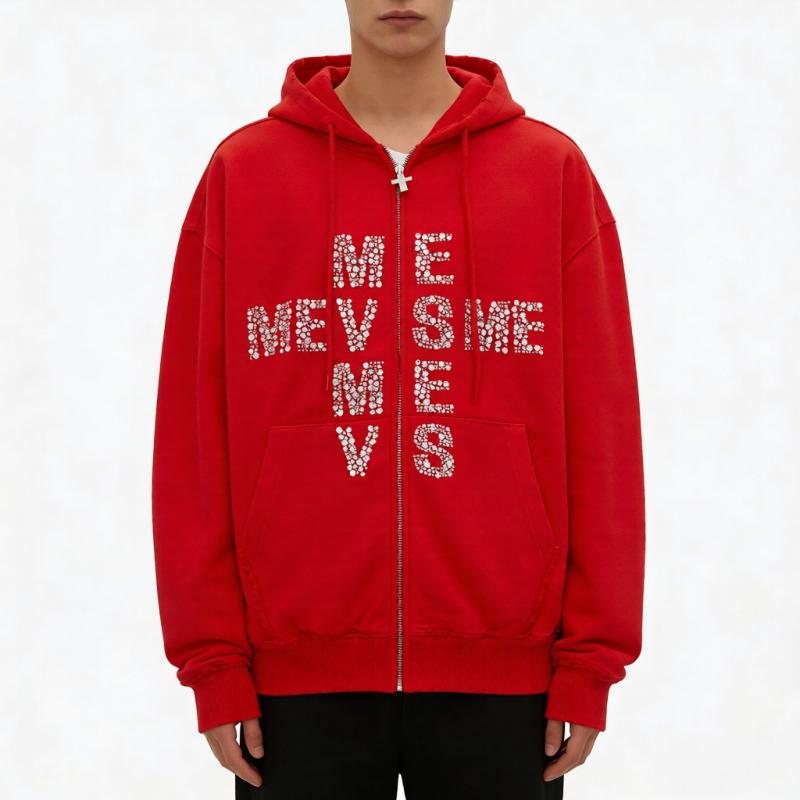
A solid fill in SS16 runs about 49 stones per square inch. A 10-by-10 chest hit is roughly 4,900 stones, or about 34 gross. A gross of glass SS16 weighs around 25 grams, so that chest hit alone is about 850 grams hanging off the front panel. Nearly two pounds.
A standard 280-300 GSM hoodie cannot hold that. It distorts, sags at the collar, stretches around the design unevenly, and within a few wears it looks like a hand-me-down. This is why decent rhinestone brands are building on 450-500 GSM heavyweight cotton fleece blanks. The body has to fight back against the weight or the whole piece collapses.
- Low Density (Outlining): Around 5-7 stones per linear inch for SS16. Weight is a non-issue.
- Medium Density (Scattered): Loose chest pattern. Mid-weight 350 GSM minimum.
- High Density (Solid Fill): 49 stones per square inch in SS16. 450 GSM or heavier, no exceptions.
This is the part of the process I care most about, honestly. You can use the best Preciosa stones in the world and a brand will still ruin the piece by spec’ing them onto a 270 GSM blank because the cost sheet said to. The body is doing as much work as the stones are.
How to Wash One Without Killing It
Inside out, cold water, delicate cycle, mesh bag, no dryer, lay flat. That’s the whole thing. Heat and abrasion are what destroy adhesive bonds; the rest is just protecting against them.
- Turn it inside out. Puts a fabric layer between the stones and the drum, which is where most of the friction damage happens.
- Mesh bag. Limits how much the body moves around, and keeps it away from zippers and metal hardware on other pieces in the load.
- Cold water, delicate cycle. Hot water softens hot-fix adhesives. You don’t want to find out which ones.
- Mild detergent. Skip the stain spray. Enzyme cleaners and pre-treats will eat fabric glue, full stop. And do not dry clean a rhinestone piece. PERC dissolves E6000.
- Air dry flat. Not hanging. A wet hoodie hanging vertically pulls the fabric down around the rigid, glued sections, and the adhesive cracks at the edges. Dryer heat will just nuke the whole thing in one cycle.
Spotting a Quality Build vs. Fast-Fashion Filler
A real build has silver-foil-backed stones, no glue bleed on the inside, clean alignment, and zero fallout out of the bag. Authentic pieces from the brands that get knocked off hardest, Sp5der, Hellstar, that lane, are using heavy LA Apparel blanks or custom 450+ GSM fleece and machine-set stones, which is what justifies the $200+ tag. The $40 replicas swap glass for acrylic and use whatever glue is cheapest that week.
7-Point Inspection Checklist:
- Stone material. Tap one lightly with a fingernail. Glass clicks. Acrylic is dull.
- Backing foil. Premium flatbacks have a bright silver foil that bounces light back through the stone. A muddy gray or weak gold-tinted back visible from the side is the cheap version.
- Adhesive bleed. Turn the body inside out and look directly behind the design. Hard dark crusts of glue soaking through the fleece, the kind that scratch your skin, mean someone overdid it or used the wrong product.
- Alignment. On any geometric pattern the spacing should be tight and consistent. Drift means somebody set it by hand and was in a hurry.
- Fabric weight. Pick it up. It should feel substantial. A thin 250 GSM body drooping under its own logo tells you everything.
- Prong snags. For set stones, drag a tissue across the surface. Prongs catching the paper means they’re sticking up and they will catch on everything else too.
- Loose stones in the bag. If there’s already fallout in the shipping box, walk.
Styling Without Crossing Into Costume
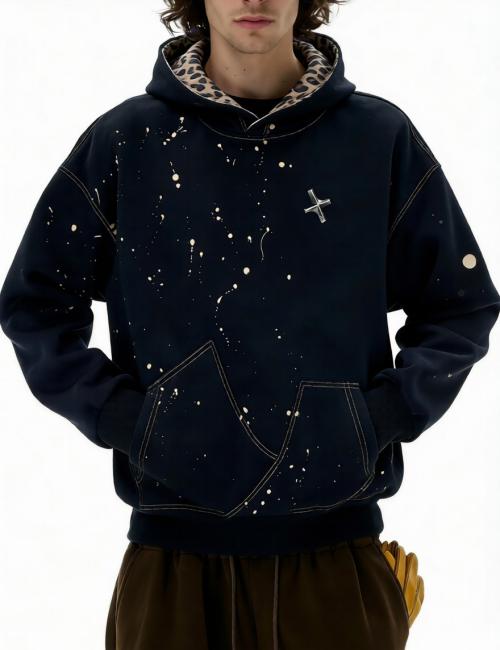
Styling is mostly about restraint. The trend came back with the Y2K wave and got pushed hard by Ice Spice and Central Cee in the current cycle. The mistake people make is treating “more shine” as the move. A bedazzled top, distressed bottom, and metallic accessories together stops being streetwear and starts being a stage fit.
- One statement piece. Heavy rhinestone hoodie with matte solid bottoms. Vintage wash denim, heavy canvas, plain cargos. Let the hoodie do the talking.
- Stone color matches the energy. Clear and AB stones throw rainbow flash and pair with loud blanks (think Sp5der pink or red 555s). Jet black on black reads textured and quiet, which is the move if you don’t want to be the brightest person in the room.
- Texture contrast. The hard reflective surface of glass plays well against brushed cotton or corduroy. Soft against hard.
- What not to wear with it. Metallic sneakers. Sequined bags. Distressed jeans that already have their own rhinestone patches. Pick one focal point.
Black-on-black jet stones are underrated, by the way.
FAQ
Are rhinestone hoodies still in style in 2026?
Yes. The Y2K revival hasn’t run out of gas and the maximalist streetwear lane is still going. Limited drops from the established labels move fast.
How do I keep rhinestones from falling off my hoodie?
Inside out, mesh bag, cold water on gentle, no harsh stain treatments, no dryer, lay it flat. Anecdotally, a well-made piece treated this way should hold its stones for a long time, but I’d avoid claiming a specific cycle count without independent testing data. Cheap glue on cheap fabric is going to fail no matter what you do, so the wash routine is also a quality test for whoever made the piece. If stones are coming off in three or four washes despite doing everything right, that’s a build problem, not a user problem.
Can I machine wash a rhinestone hoodie?
Yes, cold delicate in a mesh bag. Standard agitation and warm water will strip stones.
What’s the difference between hot-fix and flat-back rhinestones?
Hot-fix has dry heat-activated glue already on the back. Flat-back is just the bare foiled back and needs E6000 or Gem-Tac applied manually.
How much should a quality rhinestone hoodie cost?
A piece built on a 400+ GSM blank with machine-cut glass stones generally lands somewhere between $150 and $300. Under $60 you’re getting acrylic stones, a thin body, and glue that won’t survive the first wash.