
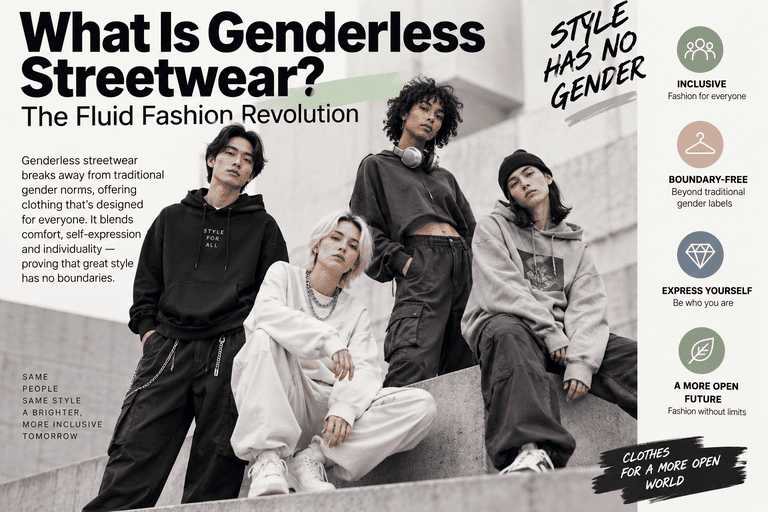
Genderless streetwear is apparel built from neutral sizing blocks that intentionally strips out the traditional binary design markers. It is not the same as unisex, which just scales down a men’s block and calls it a day. The category runs on Gen Z demand, sits inside a $26.5 billion market as of 2026, and legacy retailers still cannot figure out how to merchandise it in a physical store.
The Definition Everyone Gets Wrong: Genderless vs. Unisex vs. Androgynous
Brands use these terms interchangeably. They are not interchangeable, and the difference lives at the pattern-making stage, not in the marketing copy.
A garment labeled “unisex” is almost always a men’s block shrunk down. Wide shoulder, narrow hip, straight through the waist. It fits a certain kind of body fine and everyone else has to work around it. A genderless garment starts from a block drafted from scratch, one that isn’t leaning male or female to begin with. It’s more work, which is why most brands don’t bother.
| Term | Definition | Design Approach | Example Brand |
|---|---|---|---|
| Genderless | Apparel designed without traditional gender markers from the ground up. | Neutral sizing blocks, balanced shoulder grading, removal of darts. | Eckhaus Latta |
| Unisex | Clothing intended for any gender, defaulting to male norms. | Standard menswear sizes shrunk for smaller bodies (e.g., Men’s S = Women’s M). | Gildan |
| Androgynous | A conscious mixing of masculine and feminine visual traits. | Blending skirts with heavy workwear or sheer fabrics with tailored suits. | Harris Reed |
| Gender-fluid | Clothing chosen to reflect a shifting, non-fixed identity. | Expressive, changing silhouette choices based on daily presentation. | Orange Culture |
The Design Anatomy — What Makes a Garment Actually Genderless
A garment earns the genderless label at the pattern stage, not on the hangtag. The design pulls out bust darts, tapered waists, and any gendered hardware. What’s left is a set of technical choices you can point to on a spec sheet.
Three of them define the category:
- Neutral sizing blocks. Instead of grading off a male fit model, the pattern maker develops a neutral block. A men’s block runs wider in the shoulder and longer in the torso; a neutral one narrows the shoulder a touch and opens up the hip allowance so more body types fit into the same size. It’s a more expensive block to develop, which is basically why fast fashion won’t touch it.
- Drop-shoulder construction. By dropping the shoulder seam two to three inches down the arm, the design removes the need for a precise shoulder-width measurement. The garment drapes over broad shoulders and narrow ones without complaining.
- Single grading scale. Traditional fashion runs on dual grading, US Women’s 0-14 versus Men’s 36-46. Genderless brands operate on one scale, usually alphanumeric. The 2026 Workwear pattern book from Merchant & Mills, for instance, uses a unified XS to 3XL run across its chore jackets and trousers.
There’s a fourth thing worth mentioning, which is seam allowance philosophy, but honestly it’s inside baseball and half the brands calling themselves genderless don’t do it anyway.
Before It Had a Name — The 1980s Japanese Blueprint
Western fashion media loves to date the gender-neutral aesthetic to the mid-2010s. The architectural foundation was laid in Tokyo in the 1980s. Rei Kawakubo of Comme des Garçons and Yohji Yamamoto built entire anti-fashion empires by ignoring the gendered body completely.
Kawakubo founded Comme des Garçons in Tokyo in 1973 and debuted in Paris in 1981. Her collections actively obscured the body with heavy black fabrics, asymmetrical draping, frayed edges. The aesthetic drew on wabi-sabi, the beauty of imperfection, and the Paris press nicknamed her circle “The Crows.”
By refusing to tailor around breasts or waists, Kawakubo created a neutral zone. Her line about it: “Perfect symmetry is ugly… I want to destroy symmetry.” Yamamoto was doing something adjacent, dark oversized torn garments that the 1980s fashion press hated on arrival, and which turned out to be the exact boxy silhouette every streetwear brand is still copying forty years later.
How Streetwear Became the Vehicle (And Not Luxury or Basics)
Streetwear absorbed genderless design because the uniform was already ambiguous. Skate culture and 1990s hip-hop had normalized the oversized graphic tee, the heavy cargo, the drop-shoulder hoodie.
These pieces already obscured the body. Old outfit-inspo albums on r/streetwear show users hitting a genderless look years before the term became a marketing category, just by pairing XXL flood pants with Vans Old Skools and a black hoodie. Because streetwear prioritizes graphic language, fabric weight, and sneaker pairings over tailored fit, moving to explicit genderless marketing required almost zero structural change to the clothes. Streetwear brands didn’t reinvent the suit or the dress. They changed who they cast in the lookbook.
The Brands Actually Doing It (Not Just Labeling It)
There is a real gap between fast-fashion labels stamping “unisex” on a standard hoodie and independent brands actually engineering the pattern. The ones below run on verified genderless sizing systems.
| Brand | Founded | Price Tier | Signature Piece | Why They Qualify |
|---|---|---|---|---|
| Telfar | 2005 | $100–$420 | Shopping Bag | Telfar Clemens built the brand on 100% non-gendered sizing. |
| Eckhaus Latta | 2011 | $75–$650 | Knitwear | Mike Eckhaus and Zoe Latta work in sculptural neutral blocks. The September 2026 J.Crew collab stuck to it. |
| Big Bud Press | 2015 | $70–$130 | Heavyweight Work Pants | LA-based, uses elastic waists to fit multiple body types without gendered sizing. |
| Orange Culture | 2011 | $150–$400 | Utility Shirts | Nigerian label by Adebayo Oke-Lawal, LVMH prize finalist in 2014 for gender-fluid design. |
| Stuzo Clothing | 2010 | $50–$100 | “Free by Nature” Hoodies | BIPOC queer-owned label from Uzo Ejikeme and Stoney Michelli, exclusively gender-free streetwear. |
Notice the founding dates. Nothing on this list is newer than 2015. The category has been operating in plain sight for over a decade; the mainstream just started paying attention.
Who Wears It — Beyond the Celebrity Rolodex
Media coverage keeps pointing at Harry Styles and Billie Eilish. The actual buyer is a Gen Z shopper making routine purchases.
McKinsey’s State of Fashion 2026 report puts nearly 40% of Gen Z consumers as preferring gender-neutral fashion and beauty products, against 30% of older cohorts. Statista’s survey across 11 countries had 36% of U.S. consumers saying they’d already bought fashion items marketed outside their gender identity. The people actually wearing this stuff range from LGBTQ+ youth looking for identity-affirming pieces to straight consumers who just want the drape.
The Critique No One Publishes — Is This Just Baggy Menswear?
Here’s the thing the marketing decks skip over. A lot of “genderless” streetwear defaults to a masculine-coded neutral. When a brand scales a men’s hoodie and slaps a new label on it, they are quietly excluding specific body types while claiming to include everyone.
The complaints show up in every streetwear forum. On r/streetwear, users describe unisex hoodies that “bunch up all weird” and stay “very tight on the hips” on curvy bodies. One thread had a shopper pointing out that “with unisex tops they’re super fucking baggy too (boob space) though they can get the arm holes down to a correct size.” That mismatch is the whole problem in one sentence. The pattern is trying to solve two different geometry problems at once and picks the wrong one.
The dominant genderless silhouette, oversized, boxy, straight-cut, flatters thin androgynous frames and erases everyone else. Breasts, hips, plus-size bodies, none of them are graded for. When a brand won’t grade for curves, “genderless” in practice means “for men and thin women.” I’ve been saying this to production managers for years and I usually get a shrug back.
The Business Case — Market Size, Sales Data, and Whether Retailers Are Committing
Fortune Business Insights projects the global gender-neutral fashion market at $26.53 billion in 2026, growing to $54.12 billion by 2034. Compound annual growth rate of 9.32%.
Translating that demand into brick-and-mortar is another story. Department stores are built around strict menswear and womenswear floor plans, and when they carve out gender-neutral sections, foot traffic tends to skip them. Retail is contracting anyway. Zumiez expects to close 25 stores in 2026, and Urban Outfitters shuttered six company-owned locations in the six months ending July 2026. Right now the business case for genderless streetwear survives almost entirely on DTC e-commerce, where a search filter does the job a floor plan can’t.
How to Actually Wear It Without Costume-Playing
Wearing genderless streetwear well means shifting focus from fit metrics to proportion and drape. There’s no tailored waist, no structured shoulder. The styling is doing all the work.
- Anchor with heavy footwear. Oversized boxy clothing visually shrinks the lower leg. A chunky sneaker or combat boot under a wide-leg pant or dropped-shoulder jacket balances the weight.
- Contrast textures, not just colors. Neutral blocks strip out darting and hardware, so the depth has to come from fabric. A heavy canvas work pant with a sheer knit or silk top up top.
- Control the hemline. If the hoodie is long and boxy, the trouser should be cropped enough to show ankle. Stack too many loose long hems and you cross from streetwear into sloppy.
- Size for the shoulder, not the chest. On a neutral block, the dropped shoulder seam should land where your bicep peaks. If it slides down toward your elbow, the garment is wearing you.
That last one is the mistake I see most often, especially with people buying their first oversized piece online.
FAQ
1. Is genderless streetwear the same as unisex clothing?
No. Unisex typically takes standard men’s sizing and scales it down for smaller frames, so a Men’s Small becomes a Women’s Medium. Genderless streetwear is drafted from a completely neutral block that narrows the shoulders and opens up the hip allowance, so the garment naturally fits a wider range of bodies without a male baseline.
2. What’s the most affordable genderless streetwear brand?
Stuzo Clothing and Big Bud Press.
3. Do genderless clothes fit curvy or plus-size bodies?
Often, no. The dominant silhouette is boxy and straight, and it bunches at the hips and chest on curvy frames. A handful of brands work around this, Big Bud Press being the obvious one, by engineering pants with partially elasticated waists so the hip-to-waist ratio isn’t fighting the pattern. Most brands calling themselves genderless haven’t done that work yet, and you can usually tell within thirty seconds of trying something on. If the shoulder fits but the chest is straining or the hem flares out weirdly at the hip, you’re wearing scaled menswear with a new label on it.
4. When did genderless streetwear become mainstream?
The technical foundation was laid in 1980s Japan by Kawakubo and Yamamoto. The modern streetwear version picked up in the mid-2010s. Telfar’s 2005 launch and Eckhaus Latta’s 2011 debut set the retail blueprint that went mainstream by 2020.