
TL;DR
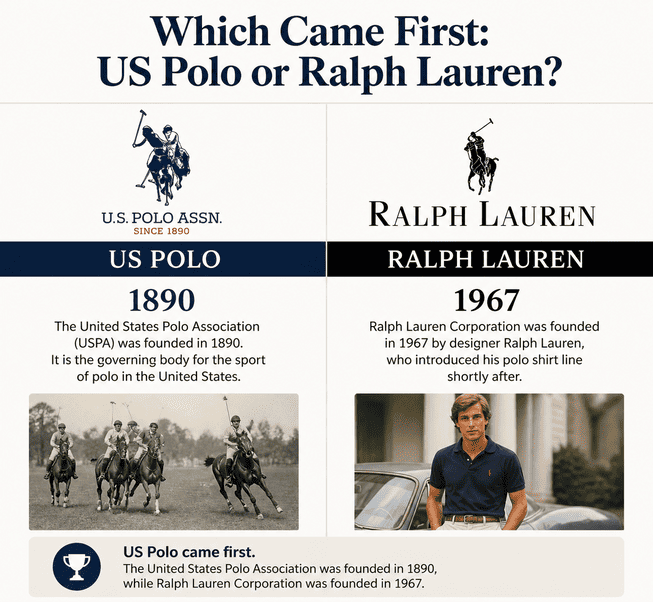
U.S. Polo Assn. came first, by about 77 years. The United States Polo Association was founded in 1890 as the governing body of the sport in America. Ralph Lauren’s Polo brand launched in 1967, originally as a line of neckties. The two get confused constantly because the logos look similar and both lean on the same horse-and-mallet imagery.
The Short Answer (and Why Almost Everyone Gets It Wrong)
The United States Polo Association was founded in 1890. Ralph Lauren’s Polo brand launched in 1967. That’s a 77-year gap, and U.S. Polo Assn. is the older entity by a wide margin.
Most shoppers assume the opposite, and you can see why. Ralph Lauren sits in the front window at Bloomingdale’s; U.S. Polo Assn. shows up in outlet plazas next to a Dress Barn. When the older brand has the cheaper price tag and the lesser shelf placement, people read it as the knockoff. Search volume reflects this. Thousands of people every month type some version of “is U.S. Polo Assn. a fake Ralph Lauren” into Google.
The reality is two separate entities entirely. One is a 19th-century sports regulator. The other is a 20th-century fashion house that borrowed the name.
Comparison at a glance:
- U.S. Polo Assn.: founded 1890
- Ralph Lauren: founded 1967
- Historical gap: ~77 years
1890 — The Founding of the United States Polo Association
The USPA did not start as a retail business. It started as a rulebook.
Established in 1890 in New York, the organization functioned as the national governing body for polo. Its first chairman, H.L. Herbert, oversaw the creation of the Westchester Polo Club and built out a system of rules for what was, at the time, a chaotically expanding sport. For its first 90 years, that’s all the USPA did. It standardized match lengths into the periods called chukkers, regulated the maximum height of polo ponies, and built the player handicap system that’s still used today. During the 1930s, USPA-sanctioned tournaments at Long Island’s Meadowbrook Polo Club drew crowds north of 30,000, mostly to watch military officers and East Coast money knock a ball around on horseback.
The organization didn’t enter the consumer apparel game until 1981, when it set up a licensing program to bring money back into the sport. That timing matters for the next 40 years of this story.
1967 — Ralph Lifshitz, Neckties, and a Borrowed Sport
Ralph Lauren, born Ralph Lifshitz in the Bronx, had no actual connection to polo. He’d never played it. He worked as a salesman for Beau Brummell, a tie manufacturer, and in 1967 he talked the company president into letting him design his own line. He called it “Polo” because the word sounded athletic, aspirational, and faintly British, which was the whole point.
With a $50,000 loan from manufacturer Norman Hilton, Lauren produced wide, four-inch silk neckties at a moment when everyone else was selling skinny. By 1968 he’d expanded to a full menswear line. In 1970, Bloomingdale’s gave him an in-store boutique, the first time the store had done that for any designer.
The horseman didn’t show up right away. In 1971, Lauren opened his first standalone shop on Rodeo Drive and released a women’s shirt with a small embroidered polo player on the cuff. In 1972 came the short-sleeve pique cotton polo shirt, in 24 colors, and that’s the product that locked the single-horseman logo into the global fashion vocabulary. The shirt did the work the neckties couldn’t.
Ralph Lauren early timeline:
- 1967: Polo necktie line launches
- 1970: Bloomingdale’s dedicated boutique opens
- 1971: Beverly Hills flagship; polo player logo debuts on women’s cuffs
- 1972: The 24-color polo shirt releases
When Two Polo Players Collide — The Lawsuit Decades
This is the part that actually explains why the two brands look the way they look on a shelf today. The litigation has been going on, on and off, since 1984, and every logo design choice you see is downstream of a court ruling.
It started in 1984. The USPA had set up its retail arm three years earlier and sued Ralph Lauren preemptively, asking the court to declare that its mounted polo player merchandise didn’t infringe on Ralph Lauren’s trademarks. Ralph Lauren countersued. U.S. District Judge Leonard Sand ruled that the USPA could use a mounted polo player mark, provided the design stayed visually distinct from Ralph Lauren’s single horseman. That ruling is the entire reason the USPA logo uses two riders instead of one.
The fight kept going. In 1999, the USPA tried to publish a magazine titled simply “Polo.” Ralph Lauren sued and won, and the magazine got renamed. In 2006, a Manhattan federal jury found that the USPA’s solid, textless double-horseman logo still infringed on Ralph Lauren’s trademark. To stay on the right side of the line, the court required the USPA to attach identifying text to its logo, things like “U.S.P.A.” or “1890.” That’s why every USPA polo shirt you pick up has lettering crammed under the riders.
The fragrance category got its own ruling. In 2012, U.S. District Judge Robert Sweet issued a permanent injunction blocking the USPA from using the double-horseman logo on perfumes and colognes. Ralph Lauren’s cosmetics business does serious revenue, and the company was not going to let anyone near it. The 2nd Circuit upheld the injunction in 2013.
Court-enforced logo rules:
- Ralph Lauren: single horseman, solid silhouette, mallet raised. No text required.
- U.S. Polo Assn.: double horseman, one mallet up and one down, with identifying text (“USPA” or “1890”) underneath.
It’s a strange thing to read a fashion brand’s design history as a series of injunctions, but that’s what this is.
Wait, So Who Actually Owns U.S. Polo Assn. Today?
U.S. Polo Assn. is owned by USPA Global Licensing Inc., the for-profit licensing arm of the United States Polo Association itself. So when someone buys a U.S. Polo Assn. shirt, some portion of that money does, eventually, flow back into collegiate polo programs, professional tournaments, and equine welfare work. Not all of it. It’s a licensing operation, not a charity. But the structural link is real, and it’s something Ralph Lauren cannot claim.
The numbers are also bigger than most people realize. USPA Global Licensing reported a record $2.3 billion in global retail revenue in 2023. The brand runs more than 1,100 mono-branded stores across 190 countries. In markets like India, Turkey, and the UAE, U.S. Polo Assn. is a serious mid-tier competitor going head-to-head with Tommy Hilfiger and Levi’s. The American shopper who only sees it at the outlet mall has a badly distorted picture of what this brand actually is globally.
Logo, Quality, Price — What’s Actually Different on the Shelf
Different shoppers, different fabrics, different stores. That’s the whole thing.
Ralph Lauren positions itself as aspirational. A Classic Fit Mesh Polo retails in the $89 to $125 range, with the upper lines going considerably higher, and the fabric is typically 100% pique cotton. Distribution leans on department stores and the brand’s own boutiques.
U.S. Polo Assn. is built for the value buyer. Polo shirts run roughly $25 to $45, the fabrics are usually cotton-poly blends, and the distribution leans on outlets and international volume. The construction is fine. It’s not luxury construction. Nobody is pretending otherwise.
On Reddit’s r/malefashionadvice, the takes from 2025 are pretty consistent. Users describe USPA as discount-oriented and reach for analogies like “Walmart vs Macy’s.” A few posters note that the shirts hold up reasonably well as daily workwear, while Ralph Lauren garments use thicker knit and better stitching that lasts noticeably longer. None of this is surprising at the price differential.
| Feature | Ralph Lauren (Polo) | U.S. Polo Assn. |
|---|---|---|
| Logo | Single horseman, no text | Double horseman with USPA text |
| Average price | $89–$125+ | $25–$45 |
| Primary fabric | 100% pique cotton | Cotton/polyester blends |
| Retail channels | Boutiques, premium department stores | Outlets, discount retailers |
| Target customer | Premium / status-oriented | Value-conscious / casual |
One more thing worth mentioning, since it comes up on the resale side: USPA pieces get listed on secondary platforms as Ralph Lauren with some regularity, sometimes by sellers who genuinely can’t tell the difference and sometimes by sellers who can.
The Counterintuitive Truth — U.S. Polo Assn. Is the “Authentic” One
If “authentic” means tied to the actual sport, the consumer perception is backwards. U.S. Polo Assn. has a 77-year head start and a direct funding line into American polo. Ralph Lauren’s Polo line has zero structural connection to the sport. The founder picked the name because it sounded like old money.
That doesn’t make Ralph Lauren’s clothing worse. Ralph Lauren outclasses USPA on fabric, tailoring, and high-fashion influence, and it’s not particularly close. But U.S. Polo Assn. isn’t a fake brand stealing an aesthetic. It’s a legitimate sporting body monetizing its own 136-year history, and it does so under restrictions a federal judge wrote.
So Which Should You Buy?
Depends on what you want the shirt to do. Neither brand is illegitimate. Both hold absolute legal rights to their respective logos.
Buy Ralph Lauren if you want:
- Heritage fashion and the recognizable status logo
- Higher-quality 100% pique cotton that resists shrinking
- Resale value on Depop or Grailed
Buy U.S. Polo Assn. if you want:
- A sporty casual look for under $40
- Workwear or daily-wear shirts you don’t mind beating up
- To send a few cents back to the actual sport of polo
FAQ
Is U.S. Polo Assn. a knockoff of Ralph Lauren?
No. The United States Polo Association predates Ralph Lauren’s Polo brand by 77 years. It was founded in 1890 as the sport’s governing body and now licenses its own heritage through USPA Global Licensing. The catch is that the USPA’s apparel line didn’t launch until 1981, well after Ralph Lauren had already built the polo shirt into a global fashion item, which is the source of all the confusion.
Why do Ralph Lauren and U.S. Polo Assn. both have a polo player logo?
Court rulings, starting with the 1984 case in front of Judge Sand. Both brands have legal rights to depict the sport, but they have to be visually distinct: Ralph Lauren gets the single horseman, USPA gets the double horseman with text.
Who owns U.S. Polo Assn.?
USPA Global Licensing Inc., the for-profit licensing arm of the United States Polo Association. Retail revenue flows back into the sport.
Is Ralph Lauren or U.S. Polo Assn. better quality?
Ralph Lauren, generally. Better fabric, tighter construction, higher price.