
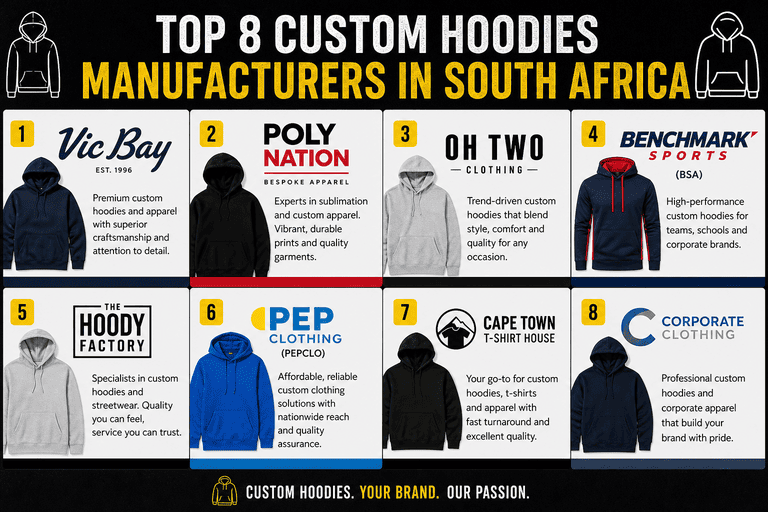
South Africa’s strongest custom hoodie manufacturers combine in-house cut-and-sew operations with local decoration, offering MOQs from 0 to 1,000+ units. This guide compares 8 vetted suppliers by MOQ, decoration methods, lead time, and price tier, so you can match a manufacturer to your order size and brand needs.
How to Actually Vet a Hoodie Manufacturer in South Africa
The South African custom apparel market is heavily fragmented. When you search for a “manufacturer,” you’re usually looking at a decorator who prints on imported blanks from China or Bangladesh. Buying from a middleman inflates your per-unit cost and limits custom fabric options. Nothing wrong with that model if you just need 100 branded hoodies for a staff braai, but it’s not manufacturing.
Before placing an order, classify your potential supplier into one of three categories:
- True CMT (Cut, Make, Trim) Manufacturers: They buy raw fabric, or in a couple of cases spin yarn locally, and cut the hoodie patterns in-house. Total control over fabric weight (GSM) and fit.
- Hybrid Decorators: They stock imported blanks in volume but handle all screen printing, DTF (Direct to Film), and embroidery in-house.
- Resellers/Promotional Agencies: They outsource both the garment supply and the printing. You’re paying two margins.
The 6-point vetting checklist:
- Manufacturing origin. Ask explicitly: “Are these cut and sewn in your factory, or are they imported blanks?” If the answer takes more than one sentence, it’s imported.
- Decoration in-house. If they outsource screen printing, your lead times will double in Q4.
- Fabric weight (GSM). Standard promo hoodies run 220–240gsm. Premium streetwear needs 290–300gsm and up. The difference in hand-feel is enormous, and honestly this is where most first-time buyers get burned. They spec by price, get a 220gsm garment, and wonder why it feels like a tracksuit top from a filling station.
- MOQ transparency. CMT factories usually demand 50+ units; blank suppliers allow zero.
- B-BBEE level. For government tenders or corporate procurement, verify their B-BBEE certificate. Level 1 or 2 is standard for serious suppliers.
- Sampling policy. Never order bulk without a physical sample. Expect to pay retail price plus a setup fee, roughly R350–R500, for a branded sample.
At-a-Glance Comparison of All 8 Manufacturers
| Manufacturer | Location | Factory Type | Decoration Methods | Fabric (GSM) | B-BBEE | Best for |
|---|---|---|---|---|---|---|
| Vic Bay | George / Cape Town | True CMT | Outsourced/Partner | 240g – 300g | Level 2 | High-volume corporate blanks |
| Poly Nation | Salt River, CT | True CMT | DTF, DTG, Screen, Embroidery | 260g – 300g+ | Ask direct | Streetwear brand launches |
| Oh Two Clothing | Glen Anil, Durban | True CMT | Screen printing | 240g – 300g | Ask direct | Custom fashion hoodies |
| Benchmark Sports (BSA) | Roodepoort, JHB | True CMT | Sublimation, Embroidery | 240g+ / Melton wool | Ask direct | Matric & school jackets |
| The Hoody Factory | Umbilo, Durban | True CMT | Screen, Embroidery | Custom | Ask direct | Sports teams & leavers |
| Pep Clothing (PepClo) | Parow, CT | True CMT | Screen, Embroidery | 220g – 260g | Level 4+ | Massive bulk contracts |
| Cape Town T-Shirt House | Milnerton, CT | Hybrid | Screen, DTG, Embroidery | 220g – 260g | Ask direct | Promo & event merchandise |
| Corporate Clothing | Johannesburg | Reseller | Screen, Transfers, Embroidery | Variable | Level 1/2 | Fast corporate gifting |
Vic Bay — Best for High-Volume Corporate Orders
Company snapshot: Founded over 30 years ago, Vic Bay runs a factory in George with distribution hubs in Johannesburg, Cape Town, Durban, and Gqeberha.
In-house capabilities: Vic Bay is one of the few completely vertical manufacturers in South Africa. They handle every step in-house: spinning raw cotton into yarn, knitting, dyeing, cutting, sewing. They specialise entirely in unbranded blank apparel for the promotional market — you won’t get printing from them directly.
Specs & pricing:
- MOQ: no minimum for blanks.
- Decoration: they produce blanks; you or a network distributor handle the branding.
- B-BBEE: Level 2 contributor.
Vic Bay is the baseline for South African corporate apparel. If you’re a procurement manager needing 500 identical polycotton hoodies for a nationwide staff rollout, Vic Bay blanks are the safest, most consistent option on the market. The limitation is obvious: they don’t print for end-users, so you’re routing branding through a decorator, which adds a link to your supply chain.
Poly Nation — Best for Streetwear Brands / Low MOQ
Company snapshot: Poly Nation operates out of a 100-year-old factory in Salt River, Cape Town’s traditional garment district. They’ve been manufacturing apparel since 1995.
In-house capabilities: Unlike traditional promotional suppliers, Poly Nation knits their own premium fabrics from ring-spun cotton. Full in-house branding: DTF, DTG, screen printing, embroidery.
Specs & pricing:
- MOQ: zero on blanks or standard stock.
- Branding: no factory tags. Garments come with generic wash care labels, so startup brands can easily attach their own neck tags.
- Lead time: stock items ship immediately; custom manufacturing runs 4–6 weeks.
This is the exact profile a startup streetwear brand needs. You can order ten premium 300gsm hoodies, print via DTG, and skip the massive inventory risk that comes with traditional CMT factory MOQs. The Salt River location matters too — it’s a five-minute drive from most of Cape Town’s independent print shops if you ever need to move fast.
Benchmark Sports Apparel (BSA) — Best for Matric Jackets & Schoolwear
Company snapshot: Based in Allen’s Nek, Roodepoort. BSA specialises heavily in custom teamwear and matric jackets.
In-house capabilities: BSA focuses on technical sportswear and heavy outerwear. They build matric jackets from the ground up, using 100% polyester, leather accents, and Melton wool with knitted trims. They run fully sublimated prints, which means the ink is bonded into the fabric — ideal for complex leaver designs with dozens of student names running down the sleeves.
Specs & pricing:
- MOQ: 30 units (standard for custom matric jacket runs).
- Decoration: sublimation, embroidery, screen print.
- Policy: strict “no replication” policy — a matric class design is never reused.
If you’re a student committee or a school procurement officer, standard promo hoodies will look cheap next to a structured, padded matric bomber jacket. BSA builds specific custom patterns rather than slapping an embroidered badge onto a pre-made imported blank. Obviously you wouldn’t send BSA a spec for a 220gsm summer hoodie — that’s not what they’re set up for.
Oh Two Clothing — Best for Heavyweight / Premium Fashion Hoodies
Company snapshot: Started in a small Durban back room in 1997 with six machinists. Oh Two has grown into a highly respected vertical apparel manufacturer in Glen Anil, Durban.
In-house capabilities: Oh Two handles the entire lifecycle: pattern-making, fabric sourcing, cutting, in-house screen printing. They cater specifically to retail and fashion — oversized fashion fits, classic pullovers, heavyweight winter garments.
I’ll admit a bias here. I still send most premium-fit briefs to Oh Two by default, even when other factories could probably do the same job at similar quality. Old habit from a client relationship that goes back years, not really justified on paper.
Specs & pricing:
- MOQ: 50 units.
- Decoration: in-house screen printing.
- Lead time: reliable because of vertical integration. They aren’t waiting for imported blank shipments to clear Durban port.
Brand owners looking for a specific drop-shoulder oversized fit or a custom 300gsm-plus brushed fleece should contact them. Because they cut and sew locally, you can dictate pocket placement and hood sizing — modifications that are basically impossible with off-the-shelf blanks.
4 More Suppliers Worth Your Consideration
The Hoody Factory. Umbilo, Durban, since 2007. Matric jackets and sports team hoodies. Free consultations for school committees. They’re highly rated for delivering on strict seasonal school deadlines, which if you’ve ever tried to get 200 matric jackets finished before the end of October, you know is not trivial.
Pep Clothing (PepClo). Parow, Cape Town. Over 2,000 staff, 15 million garments a year. The only logical choice for massive government tenders or nationwide retail chains requiring thousands of basic hoodies per month. Don’t call them for 50 units.
Cape Town T-Shirt House. Milnerton since 1992. A large importer and distributor, supplying 100% combed cotton hoodies with MOQs typically between 20 and 50 units for custom branding. Good for fast event merchandise.
Corporate Clothing. Johannesburg-based hybrid supplier, strictly corporate sector. They rely on blank brands but their turnaround on embroidered corporate uniforms is fast.
Cost Breakdown — What Custom Hoodies Actually Cost in South Africa
Custom hoodies in South Africa typically run between R119.00 and R350.00 per unit depending on fabric weight, order size, and decoration method. Below are real ZAR pricing scenarios based on 2026 data from local blank suppliers like T-Shirts Joburg.
All prices below are estimated per unit and include 15% VAT, but exclude courier delivery.
Scenario A: Budget Event Hoodies (220gsm)
- Best for: giveaways, NGOs, one-off events
- Blank cost: R119.00 (220gsm Poly Brushed Fleece)
- 1-colour screen print (chest): ~R25.00
- Setup fee (divided by 100 units): ~R3.50
- Total per unit: ~R147.50
Scenario B: Standard Corporate Uniforms (290gsm)
- Best for: staff winter uniforms, sports clubs
- Blank cost: R199.00 (290gsm Heavyweight Polycotton)
- Left-chest embroidery: ~R35.00
- Digitizing setup fee (divided by 50 units): ~R5.00
- Total per unit: ~R239.00
Scenario C: Premium Streetwear Brand (500g Heavyweight)
- Best for: retail brands, luxury merchandise
- Blank cost: R289.00 (500g Premium Fleece)
- DTF print (front and back): ~R65.00
- Custom woven neck label application: ~R15.00
- Total per unit: ~R369.00
One thing these numbers don’t show: setup fees kill you on small runs. That R350 screen setup fee spread across 20 hoodies is R17.50 a unit; spread across 200 it’s negligible. Plan your reorder volume before you commit to a decoration method.
Choosing the Right Manufacturer for Your Use Case
Selecting a factory comes down to matching your primary constraint — budget, speed, or customisation — to the manufacturer’s core business model.
- Launching a streetwear brand? Poly Nation. You can buy 10 unbranded 300gsm ring-spun cotton hoodies, test designs on their DTG printers, and attach your own labels without dropping capital on huge MOQs.
- Need 500 staff hoodies next week? Ask a local printer to source Vic Bay blanks. Stock exists locally, the 240gsm polycotton is durable, and you skip the 6-week cut-and-sew queue entirely.
- Want a custom oversized fit? Oh Two Clothing. Their 50-unit MOQ lets you modify the physical pattern rather than accepting a generic fit.
- Ordering for a matric class? Call Benchmark Sports Apparel or The Hoody Factory. They understand the padding, Melton wool, and complex sublimation that leaver jackets actually require.
FAQ
What’s the minimum order for custom hoodies in South Africa?
MOQs range from 0 units for blank importers like Poly Nation to 50 units for true cut-and-sew manufacturers like Oh Two Clothing. Custom fabric colours or specific fits usually trigger a strict 50–100 unit minimum to cover fabric roll costs.
Are custom hoodies in South Africa actually manufactured locally?
Many are simply imported from China or Bangladesh and printed here. To get a truly local garment, you have to explicitly hire a CMT factory such as Vic Bay, Oh Two Clothing, or Poly Nation, which cuts raw fabric in South Africa. Ask about origin before you sign anything. Ask twice if the salesperson gets vague. There’s no shame in an imported blank — plenty of good brands run on them — but you deserve to know which one you’re buying, and the price you pay should reflect it.
How much does one custom hoodie cost in bulk in ZAR?
A standard 290gsm polycotton hoodie is around R199.00 including VAT, plus R25.00–R40.00 for basic screen printing or embroidery. Heavyweight 500g fashion hoodies cost upwards of R289.00 before decoration.
Screen printing vs. DTF vs. embroidery on hoodies — which lasts longest?
Embroidery outlasts the garment. For large graphics, traditional plastisol screen printing outlasts DTF transfers, though DTF is much cheaper for complex, multi-colour designs at low volumes.
How long does bulk hoodie production take in SA during peak season (Q3–Q4)?
During the winter rush (April to July) and the year-end corporate gifting window (October to November), true CMT lead times stretch from a standard 3 weeks to 6–8 weeks.