
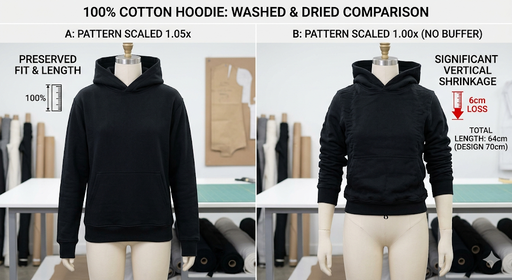
Look, I’ve been on factory floors for 30 years. I’ve seen countless “Instagram-famous” brands launch with a bang, only to go bankrupt three months later. The reason? The “Crop-Top” Disaster. They ship a perfect 70cm hoodie, the customer washes it once, and it shrinks to 64cm. Suddenly, your “Boxy Fit” is a midriff-baring mistake. If you’re working with 100% cotton, you aren’t just cutting fabric; you’re managing a living, breathing, and incredibly stubborn material.
Here’s the reality of 1.05x scaling—the insurance policy every serious brand needs.
1. The “Spring-Back” Effect (The Real Physics)
Forget the textbook “cellulose” talk. Think of cotton fibers as tiny springs. During the knitting and dyeing process, the machines pull and stretch these “springs” to their breaking point just to keep the fabric flat on the roll.
The moment that fabric hits your customer’s warm wash cycle, those “springs” finally relax. They snap back. This isn’t just “shrinkage”; it’s the fabric returning to its natural state. On heavyweight fleece (400GSM+), this “snap back” is aggressive—often losing up to 7% in length (the Warp) but only 2% in width (the Weft).
Master Tip: This is why you never scale a pattern equally. If you just “upsize” everything by 5%, your sleeves will be perfect but your body will be too wide. You need to scale the length more aggressively than the width.
2. The 1.05x Math: It’s Not Guesswork, It’s Grading
I tell my clients: “Cut for the second wear, not the first.” When we apply the 1.05x factor, we are building a buffer for that inevitable first wash.
A 70cm Body Length becomes 73.5cm. * A 65cm Sleeve becomes 68.2cm. Your cutting room manager will probably complain. “Boss, we’re wasting 5% more fabric per marker!” Let them complain. It is infinitely cheaper to “waste” 5% of your fabric on the cutting table than to refund 100% of your orders when the hoodies don’t fit.
3. The “Bacon Neck” & Ribbing Tension
One thing AI writers and rookie designers always miss is the Differential Shrinkage.
If your hoodie body is 100% cotton but your ribbing (cuffs and hem) has 5% Spandex, they will shrink at different rates. If you don’t calculate the tension of the ribbing against the scaled body, you get what we call “Bacon Neck”—that wavy, distorted collar that makes a $100 hoodie look like a $5 rag.
Information Gain: Always demand a “Wash-to-Dry” test for both the shell and the ribbing separately before you hit the “Start” button on the cutting machine.
4. The Industry Secret: The “Grain Line” Matters
Standard factories cut for efficiency (how many pieces can we fit on one yard). Premium factories cut for stability. If you want the Supreme-style longevity, you use Crossgrain cutting. You rotate the pattern 90 degrees so the “springs” we talked about are running horizontally. It costs more in fabric wastage, but it makes the vertical shrinkage nearly zero. If you aren’t doing Crossgrain, that 1.05x multiplier is your only line of defense.
5. Final Word: Test, Don’t Guess
Don’t take my word for it. Every fabric lot is different. One batch of “Jet Black” might shrink more than “Vintage Grey” because of the heat used in the dyeing vat.
My SOP for you: 1. Cut a 50x50cm square. 2. Wash it hot. Dry it high. 3. Measure it. 4. If it’s 47cm now? Your scaling factor isn’t 1.05—it’s 1.06.
In this business, the difference between a “Luxury Essential” and a “Cheap Rag” is exactly 3.5 centimeters. Choose wisely.